

1. When approaching a sharp curve, motor vehicle drivers should reduce speed only after entering the curve.
A. Right
B. Wrong
Answer: B
2. When a motorcycle turns at an excessively high speed, it can easily dash out of a curve or skid sideways.
A. Right
B. Wrong
Answer: A
3. If a motorized vehicle driver has caused a major accident in violation of the traffic regulations which has caused heavy loss to public or private property, the driver is subject to a prison term of less than 3 years or a criminal detention.
A. Right
B. Wrong
Answer: A
4. A light motorcycle ______________.
A. can carry children who do not reach 12 years old
B. can carry adults who are more than 18 years old
C. cannot carry people
D. can carry preschoolers
Answer: C
5. What is the meaning of this sign?
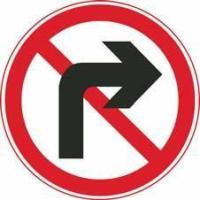
A. no entering the intersection
B. no right turn
C. no changing lane
D. no U turn
Answer: B
6. In which situation the traffic police may detain the vehicle?
A. no vehicle registration papers
B. no insurance contract
C. no lable of environmental protection
D. no label of insurance
Answer: D
7. When a motorized vehicle returns to the original lane after overtaking, the driver should Turn on the right-turn signal.
A. Right
B. Wrong
Answer: A
8. What should be done by the driver who intends to overtake but finds that the vehicle in front is also overtaking?
A. Following the vehicle in front closely and finding a chance to overtake it
B. Accelerating to overtake forcefully
C. Continuously sounding the horn to urge the vehicle in front to yield
D. Refraining from overtaking and letting the vehicle in front overtake first
Answer: D
9. Which behavior a person had in 3 years is not allowed to apply for a motorized vehicle driving license?
A. insulin injections
B. drunken experience
C. smoking addiction
D. drug injections
Answer: D
10. Drivers who ride motorcycles are able to not wear safety helmets.
A. Right
B. Wrong
Answer: B
11. What is the meaning of this sign?
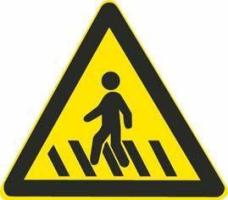
A. watch for pedestrians
B. watch for children
C. school area
D. crosswalk
Answer: A
12. It is not a bad habit for a driver to frequently change lanes.
A. Right
B. Wrong
Answer: B
13. When driving a motorcycle, the driver may wear slippers for the sake of safety.
A. Right
B. Wrong
Answer: B
14. How to do if there is a traffic jam in intersection?
A. borrow the opposite lane to pass
B. stop and wait outside the intersection
C. cut in the front vehicles to pass
D. enter the intersection and wait
Answer: B
15. How to cross each other on a narrow mountain road without the central dividing line?
A. The vehicle not close to the mountain goes first
B. The vehicle close to the mountain goes first
C. The empty vehicle goes first
D. The slow-moving vehicle goes first
Answer: A
16. When encountering an overflowing bridge, the driver should look at the situation, and passes through slowly before he makes sure that it is safe to do so.
A. Right
B. Wrong
Answer: A
17. How to ensure motor vehicles have sufficient power when driving uphill?
A. Downshift before reducing speed
B. Downshift after reducing speed
C. Downshift when the speed is excessively low
D. Downshift to the fullest extent
Answer: A
18. What should be done by the driver who intends to overtake but the motor vehicle in front neither reduces its speed nor allows the right of way?
A. Continuously sounding the horn and accelerating to overtake
B. Accelerating and continuing to overtake
C. Refraining from overtaking
D. Following the vehicle in front closely and finding a chance to overtake
Answer: C
19. If a motorized vehicle driver drives on the road after getting drunk is subject to a prison term of more than 3 years.
A. Right
B. Wrong
Answer: B
20. What is the meaning of this sign?
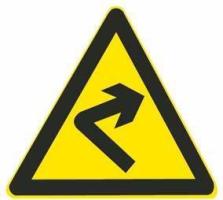
A. sharp right curve
B. bypass from right side
C. continuous curves
D. sharp left curve
Answer: A