

1. What is the meaning of this sign?
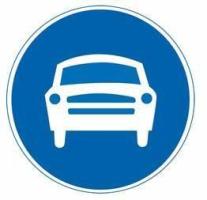
A. no passing for small vehicle
B. passing for small vehicle only
C. passing for motorized vehicle
D. no passing for small vehicle
Answer: C
2. When using emergency brake, be aware of keeping the body of the motorcycle being perpendicular to the ground to avoid sideslip.
A. Right
B. Wrong
Answer: A
3. When a motorcycle goes down a long slope, it should run at a lower gear and fully use the engine to brake.
A. Right
B. Wrong
Answer: A
4. When a motorized vehicle breaks down on the road and is difficult to move, the driver should place a warning sign within 50 meters behind the vehicle.
A. Right
B. Wrong
Answer: B
5. A person who falsifies, alters driving license or uses falsified, altered driving license, and if his act constitutes a crime, he should be held for criminal liabilities according to law.
A. Right
B. Wrong
Answer: A
6. When a motorcycle reaches a muddy or burst-and-muddy section, the driver should stop, observe and select the level and solid section or the section with vehicle tracks.
A. Right
B. Wrong
Answer: A
7. When a motorized vehicle returns to the original lane after overtaking, the driver should Turn on the right-turn signal.
A. Right
B. Wrong
Answer: A
8. What is the main impact of foggy weather on safe driving?
A. Easy to slide sideways
B. Low visibility
C. Increase the resistance
D. Widen the field of vision
Answer: B
9. Traffic Police can detain the vehicle according to law if it uses other vehicle’s license plate and vehicle license.
A. Right
B. Wrong
Answer: A
10. When a motorized vehicle crosses a non-motorized vehicle on a narrow road or a narrow bridge at night, the motorized vehicle should use the high beam light.
A. Right
B. Wrong
Answer: B
11. Which is subject to a 12-point penalty?
A. driving a motorized vehicle when driving license is temporarily detained
B. applying for reissuing the driving license by concealment or deception
C. not yielding to the school bus according to regulations
D. running with the license plate deliberately stained
Answer: D
12. A motorized vehicle driver who uses falsified or altered driving license is subject to a 12-point penalty.
A. Right
B. Wrong
Answer: A
13. What is the meaning of this sign?
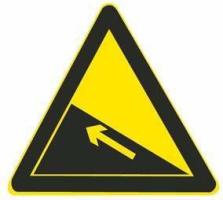
A. steep downhill road
B. continuous up slopes
C. steep uphill road
D. embankment road
Answer: C
14. Besides the administrative punishment, what kind of system implemented by the traffic control department of the public security organ to the driver who violated the traffic regulations?
A. violation registration system
B. mileage reward system
C. mandatory write-off system
D. accumulated penalty points system
Answer: D
15. When the driver discovers that steering is stiff, the wrong measure is to ___________.
A. Reduce speed and stop the vehicle as fast as possible
B. Stop at a safe place
C. Continue to drive
D. Identify the cause
Answer: C
16. If a person who has caused a major traffic accident and if his act constitutes a crime, he may not be held for criminal liabilities.
A. Right
B. Wrong
Answer: B
17. What is the meaning of this sign?
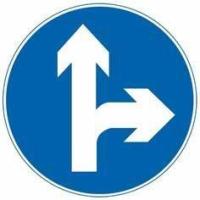
A. going straight and left turn
B. going straight and right turn
C. no going straight and no right turn
D. left turn and right turn only
Answer: B
18. Traffic Police can detain the accident vehicle according to law if it needs to be collected evidence of the road accident.
A. Right
B. Wrong
Answer: A
19. Speed up when passing the overflowing road.
A. Right
B. Wrong
Answer: B
20. When passing a turn or a curve section, the driver should slow down and disengage the clutch.
A. Right
B. Wrong
Answer: B