

1. In the course of making a U turn, the driver should strictly control the speed, carefully observe the road conditions before and behind the vehicle, and may advance or reverse only if it is safe to do so.
A. Right
B. Wrong
Answer: A
2. If one drives an illegally assembled motorized vehicle, he should not only pay the fine, but also ________ .
A. be confiscated the driving license
B. be revoked the driving permission
C. be forced to recover the vehicle condition
D. be revoked the driving license
Answer: D
3. In which situation the traffic police can detain the vehicle according to law?
A. exceeding 10% of the prescribed speed limits
B. driving when he is exhausted
C. not buckled up while driving
D. driving after drinking
Answer: D
4. Whats the meaning of this guide arrow?

A. Y-shaped intersection ahead
B. separate road ahead
C. only left or right turn ahead
D. merging with both sides ahead
Answer: C
5. Is there any effective auxiliary method to control the speed while driving on a long downhill road besides braking.
A. Shift to the neutral gear and slide
B. Use the engine to brake
C. Turn off the engine and slide
D. Depress the clutch and slide
Answer: B
6. Traffic signals include Traffic lights, Traffic signs and Command of the traffic police.
A. Right
B. Wrong
Answer: A
7. How to do while entering this intersection?

A. shift the high and low beam lights alternately to remind the cars already in the intersection to yield
B. quickly cut in the cars already in the intersection
C. let the cars already in the intersection go first
D. honk and enter directly
Answer: C
8. Do not hang or place articles close to the front and rear windows that block the vision of the driver.
A. Right
B. Wrong
Answer: A
9. Which is correct in this kind of intersection?

A. make a U turn along the left lane
B. cannot make a U turn
C. make a U turn through the middle lane
D. make a U turn inside the intersection
Answer: B
10. Whats the meaning of this sign?

A. max speed
B. speed limit
C. speed recommended
D. mini speed
Answer: C
11. The safety pillow is used to protect the driver??s head when there is a rear-end collision.
A. Right
B. Wrong
Answer: B
12. Whats the meaning of this sign?
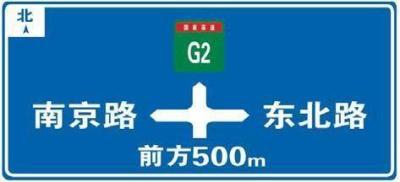
A. lane information indication
B. road branching point ahead
C. place and distance indication
D. intersection ahead
Answer: D
13. Full penalty points of a scoring cycle because of violating the traffic regulations is 12 points.
A. Right
B. Wrong
Answer: A
14. This set of the hand signals of the traffic police indicates that the vehicles should ___ .
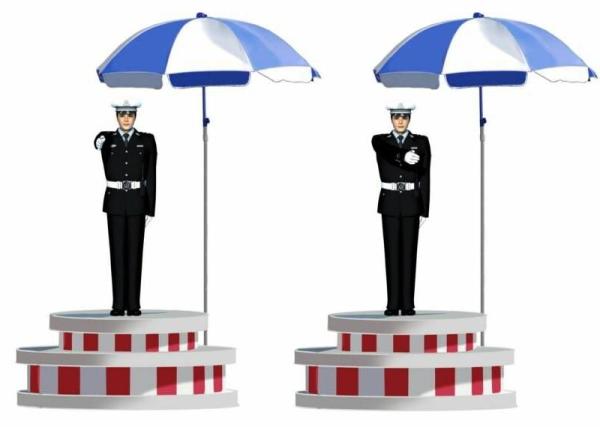
A. turn right
B. reduce speed and pass slowly
C. pull over
D. change lane
Answer: D
15. What device does the switch of this symbol control?
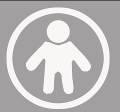
A. child safety lock
B. window glasses of both sides
C. electric door
D. door unlock
Answer: A
16. No turning left in this situation.
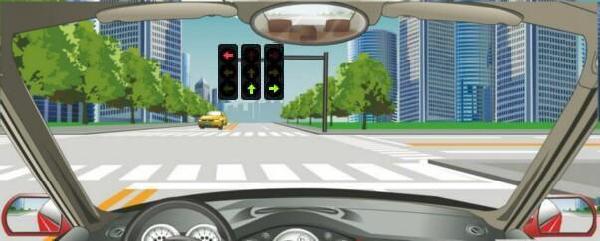
A. Right
B. Wrong
Answer: A
17. Which behavior a person had in 3 years is not allowed to apply for a motorized vehicle driving license?
A. insulin injections
B. drunken experience
C. smoking addiction
D. drug injections
Answer: D
18. Whats the meaning of this guide arrow?

A. indicate changing to left lane
B. indicate changing to left lane
C. indicate making a U turn ahead
D. indicate turning right ahead
Answer: D
19. Which should be carried onboard?
A. insurance policy
B. vehicle license
C. certificate of ex-factory inspection
D. vehicle registration papers
Answer: B
20. A motorized vehicle driver who illegally occupies the emergency lane on the expressway is subject to a 6-point penalty.
A. Right
B. Wrong
Answer: A