

1. A motorized vehicle driver who uses falsified or altered driving license is subject to a 12-point penalty.
A. Right
B. Wrong
Answer: A
2. How to use lights when pulling over on road?
A. turn on the hazard lights
B. turn on the right-turn signal in advance
C. use the high and low beam lights alternately
D. not need to use any light to indicate
Answer: B
3. If a motorized vehicle driver has caused a major accident in violation of the traffic regulations which has caused heavy loss to public or private property, the driver is subject to________.
A. a prison term of more than 3 years
B. a prison term of less than 3 years or a criminal detention
C. a prison term of 3 ~ 7 years
D. a prison term of more than 5 years
Answer: B
4. Driving license will be detained if you allow to drive your car.
A. driver during the period of probation
B. driver who has obtained a driving license
C. one whose driving license been revoked
D. one whose penalty points reach 6 points
Answer: C
5. When a motorized vehicle returns to the original lane after overtaking, the driver should Turn on the right-turn signal.
A. Right
B. Wrong
Answer: A
6. If a motorized vehicle driver has caused a major traffic accident in violation of the traffic regulations which has caused human death due to his escaping, the driver is subject to a prison term of _________.
A. less than 2 years
B. less than 3years
C. less than 7years
D. more than 7 years
Answer: D
7. Which shoud be taken along while driving?
A. vocational qualification certificate
B. ID card
C. driving license
D. work permits
Answer: C
8. What is the meaning of this sign?
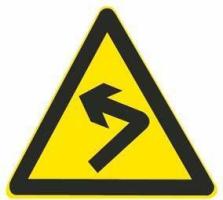
A. bypass from left side
B. continuous curves
C. sharp left curve
D. sharp right curve
Answer: C
9. What is the meaning of this sign?
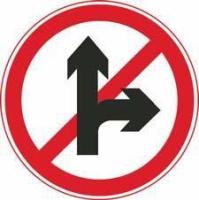
A. no going straight and no changing to left lane
B. no going straight and no left turn
C. allowed to go straight and change to left lane
D. no going straight and no right turn
Answer: D
10. If a motorized vehicle causes a traffic accident on the road, the driver should immediately move the vehicle to the roadside.
A. Right
B. Wrong
Answer: B
11. When a motorized vehicle crosses a non-motorized vehicle on a narrow road or a narrow bridge at night, the motorized vehicle should use the high beam light.
A. Right
B. Wrong
Answer: B
12. When driving on a foggy day, the driver should turn on the fog lamp.
A. Right
B. Wrong
Answer: A
13. What is the meaning of this sign?

A. no stopping temporarily
B. no long stopping
C. no stopping
D. long stopping is allowed
Answer: B
14. Which is subject to a 12-point penalty?
A. driving a motorized vehicle when driving license is temporarily detained
B. applying for reissuing the driving license by concealment or deception
C. not yielding to the school bus according to regulations
D. running with the license plate deliberately stained
Answer: D
15. How to cross each other on a narrow mountain road without the central dividing line?
A. The vehicle not close to the mountain goes first
B. The vehicle close to the mountain goes first
C. The empty vehicle goes first
D. The slow-moving vehicle goes first
Answer: A
16. The traffic police may detain the motorcycle if its driver has falsified the license plate and vehicle license.
A. Right
B. Wrong
Answer: A
17. What is the meaning of this sign?

A. customs inspection
B. stop-for-inspection
C. frontier inspection
D. no passing
Answer: B
18. Traffic Police can detain the vehicle according to law if it uses other vehicle’s license plate and vehicle license.
A. Right
B. Wrong
Answer: A
19. When a tire blowout on the road, the driver should swiftly depress the brake pedal to reduce speed, do all his can to control the steering wheel and stop the vehicle as soon as possible.
A. Right
B. Wrong
Answer: B
20. Before a motorized vehicle overtakes, the driver should turn on the left-turn signal, use the high and low beam lights alternately or honk in advance.
A. Right
B. Wrong
Answer: A