

1. Whats the meaning of this sign?
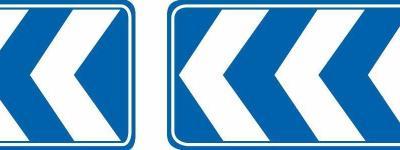
A. line guide signs
B. lane merging guide signs
C. lane branching guide signs
D. turning guide signs
Answer: A
2. What is the max speed on the expressway when the visibility is lower than 100 meters?
A. less than 40km/hr
B. less than 60km/hr
C. less than 80km/hr
D. less than 90km/hr
Answer: A
3. When a motorized vehicle breaks down on the expressway, the persons on board should swiftly move to the right side road shoulder or emergency lane, and report to the police rapidly.
A. Right
B. Wrong
Answer: A
4. Driving a small passenger vehicle on the expressway, the minimum speed should not be less than 90 kilometers per hour.
A. Right
B. Wrong
Answer: B
5. It lights while driving to indicate that ______

A. engine temperature is too high
B. engine cooling system malfunction
C. engine lubrication system malfunction
D. engine temperature is too low
Answer: A
6. What marking is it?

A. prohibitive area
B. cross-hatched marking
C. guide line
D. central circle
Answer: D
7. When a vehicle changes lane before an intersection, the driver should do so ______.
A. In the area marked by solid lines before the intersection
B. In the area marked by solid lines in the intersection
C. In the area marked by broken lines as indicated by the guide arrow
D. Before the stop line at the intersection
Answer: C
8. Whats the meaning of this sign?
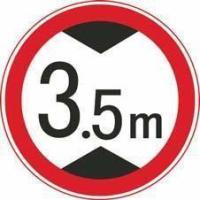
A. 3.5m width limit
B. 3.5m width limit ban is lifted
C. 3.5m distance from vehicles limit
D. 3.5m height limit
Answer: D
9. This sign warns a sharp left curve ahead.
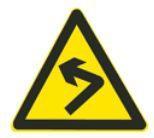
A. Right
B. Wrong
Answer: A
10. Motor vehicle frontal collision, the double protection of the airbag and the safety belts can give full play to the role.
A. Right
B. Wrong
Answer: A
11. Driving in a dusty weather, it does not needed to turn on the head light, the contour light and the tail light.
A. Right
B. Wrong
Answer: B
12. What does this symbol indicate?

A. switch of high beam lights
B. switch of the low beam lights
C. master switch of vehicle lights
D. the switch of tail fog light
Answer: C
13. When a vehicle follows another vehicle on a mountain road, it should ____.
A. Properly increase the safe distance
B. Closely follow the vehicle in front
C. Properly reduce the safe distance
D. Try to find a chance to overtake
Answer: A
14. If a vehicle has the right of way at an intersection but encounters a vehicle cutting in, the driver should _________.
A. Rush to pass
B. Speed up in advance and pass
C. Reduce speed and evade, or stop to yield when necessary
D. Go forward at the normal speed according to the right of way and refuses to evade
Answer: C
15. Stop and yield to the pedestrians under this situation.
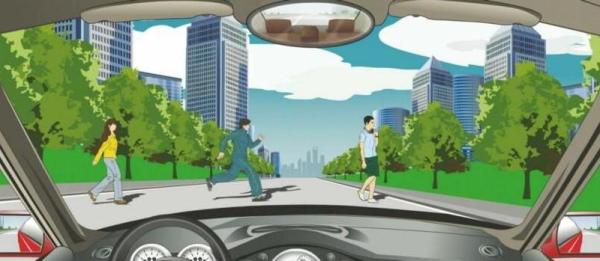
A. Right
B. Wrong
Answer: A
16. How to use lights in this weather condition?
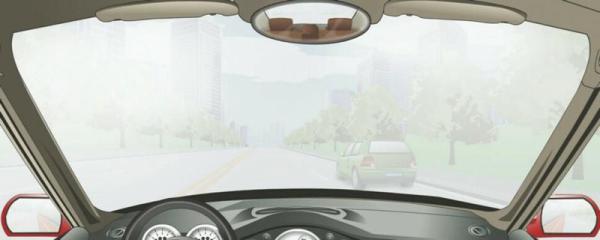
A. use high beam lights
B. use fog lights
C. not use any light
D. turn on the right-turn signal
Answer: B
17. How often should a driver who is more than 60 years old present the certificate of physical conditions?
A. every 3 years
B. every 2 years
C. every 6 months
D. every 1 year
Answer: D
18. If a driving license has been revoked as it is obtained by deception, bribery or other illegal means, the applicant is not allowed to re-apply for it within ______
A. 6 months
B. 1 year
C. 2 years
D. 3 years
Answer: D
19. When a motorized vehicle runs on an expressway, it ________.
A. May stop on the road shoulder to let passengers on and off
B. May stop in the emergency lane to load and unload cargos
C. May overtake or stop in the acceleration or deceleration lane
D. Is not allowed to drive or stop in the emergency lane in a non-emergency case
Answer: D
20. It lights continuously to indicate that airbag is working.

A. Right
B. Wrong
Answer: B