

1. What is the meaning of this sign?
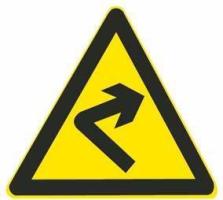
A. sharp right curve
B. bypass from right side
C. continuous curves
D. sharp left curve
Answer: A
2. One who runs away after causing a traffic accident and constitute a crime can not apply for motorized vehicle driving license.
A. Right
B. Wrong
Answer: A
3. Which of the following vehicle in front in the same lane is not allowed to be overtaken?
A. large truck
B. fire engine on duty
C. public bus
D. large bus
Answer: B
4. Before a motorized vehicle overtakes, the driver should turn on the left-turn signal, use the high and low beam lights alternately or honk in advance.
A. Right
B. Wrong
Answer: A
5. In which situation that a driver will not allowed to drive?
A. penalty points reach 10 points
B. penalty points reach 6 points
C. driving license lost or destroyed
D. driving license is nearly expired
Answer: C
6. If a driver has not received full penalty points, and the fine has not been paid, the penalty points will be transferred into the next scoring cycle.
A. Right
B. Wrong
Answer: A
7. If a motorized vehicle driver allows his vehicle to be driven by a person whose driving license has been detained, the traffic police will serve an oral warning.
A. Right
B. Wrong
Answer: B
8. How should a motor vehicle follow the other vehicle In front when driving on a road covered with ice and snow?
A. Keep a long safe distance
B. Turn on hazard lamp
C. Change between high-and-low beam alternatively
D. Sound the horn in due time to give a notice to the vehicle in front
Answer: A
9. A driver can park the vehicle by borrowing the sidewalk if he cannot find the parking area.
A. Right
B. Wrong
Answer: B
10. What is the meaning of this sign?
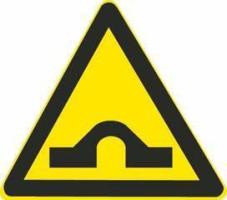
A. hump bridge
B. high outburst road
C. low-lying road
D. bump road
Answer: A
11. The police can detain the vehicle if one drives a vehicle without ______
A. vehicle license
B. ID card
C. pass paper
D. qualification certificate
Answer: A
12. After setting off from a roadside, motor vehicle drivers should watch both sides of the road, turn left and drive into the normal lane slowly.
A. Right
B. Wrong
Answer: A
13. When causing a road accident involving property damage, the party should leave the scene on his own but he does not leave, the traffic police can not order him to leave.
A. Right
B. Wrong
Answer: B
14. If a person who has caused a major traffic accident and if his act constitutes a crime, he should be held for _________.
A. criminal liability
B. civil liability
C. direct liability
D. economic liability
Answer: A
15. What is the meaning of this sign?
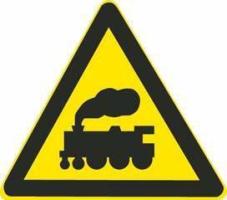
A. watch for long time honking
B. an unmanned level crossing
C. a manned level crossing
D. multi-crossing of railway and road
Answer: B
16. When using emergency brake, be aware of keeping the body of the motorcycle being perpendicular to the ground to avoid sideslip.
A. Right
B. Wrong
Answer: A
17. A light motorcycle is only permitted to carry preschoolers.
A. Right
B. Wrong
Answer: B
18. After causing a road accident, the vehicle driver needs to change the scene for rescuing the wounded, the driver should mark the location.
A. Right
B. Wrong
Answer: A
19. When the driver is suspected of drinking or drunk in a traffic accident, preserve the scene and immediately report to the police.
A. Right
B. Wrong
Answer: A
20. In which situation the traffic police may detain the vehicle?
A. no lable of inspection
B. no ID card
C. no lable of environmental protection
D. no vehicle registration papers
Answer: A