

1. What is the meaning of this sign?
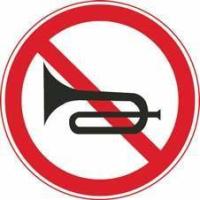
A. No long time honking
B. Honk discontinuously
C. Reduce speed and honk
D. No honking
Answer: D
2. When a motor vehicle passes over an overflowing bridge, what should the driver do after stopping and observing closely?
A. Change to a high gear and pass rapidly
B. Constantly observe the changes of the flow
C. Prepare to stop at any time
D. Change to a low gear and pass through at a constant speed
Answer: D
3. For a temporary stop on a foggy day, the driver should only turn on the fog lamp and the low-beam
A. Right
B. Wrong
Answer: B
4. What is the meaning of this sign?
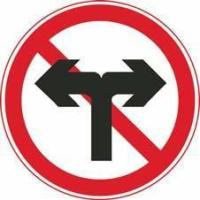
A. No U turn at intersection
B. No changing lane from both sides
C. No left or right turn
D. No going straight
Answer: C
5. What is the meaning of this sign?
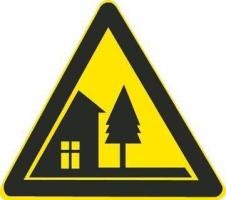
A. Watch for pedestrians
B. Crosswalk
C. Village or town
D. Primary school
Answer: C
6. Before driving, it is necessary to check whether the cooling liquid, engine oil and fuel oil, are leaking.
A. Right
B. Wrong
Answer: A
7. When a motor vehicle reaches a muddy or burst-and-muddy section of the road, the driver should stop, observe and select a level and solid section or a section with vehicle tracks.
A. Right
B. Wrong
Answer: A
8. When driving motor vehicles on the uphill section of a mountain road, the driver should _____.
A. Always pay attention to downstream vehicles
B. Advance at a uniform speed.
C. Avoid shifting whenever possible
D. Choosing high speed gear
Answer: ABC
9. When the driver discovers a tire is leaking and steers the vehicle off the main driving lane, he/she should refrain from applying emergency braking so as to avoid a vehicle turnover or a rear-end collision arising from the late braking of the vehicle behind.
A. Right
B. Wrong
Answer: A
10. What are the hazards of drivers using cellphones or texting while driving?
A. Influencing driving operation
B. Influencing the rest of passengers
C. Failure to respond to emergencies
D. Distracted driving
Answer: ACD
11. What should be done by motor vehicle drivers in order to yield politely to such pedestrians?
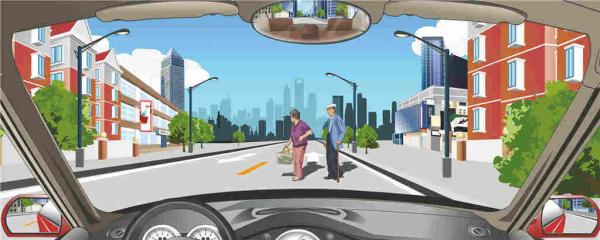
A. Speed up and bypass in front of the pedestrians
B. Speed up and bypass from behind the pedestrians
C. Reduce speed or stop to yield
D. Continuously sound the horn to alert the pedestrians
Answer: C
12. What is the meaning of this sign?
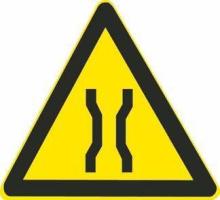
A. Road narrows on the left side
B. Narrow bridge
C. Narrow road
D. Road narrows on the right side
Answer: B
13. Driving a motor vehicle in the downhill section of a mountain road avoids overtaking as much as possible because _______.
A. Vehicle resistance in downhill section is very high
B. Vehicles on downhill sections are more difficult to control than on flat roads due to gravity.
C. In downhill section, the front speed is faster and it is difficult to overtake.
D. Vehicles on downhill sections tend to be too fast due to gravity
Answer: BD
14. When a tire bursts suddenly on the road, the driver should refrain from violently depressing the brake pedal in panic. Instead, he/she should try his/her best to change to a low gear and use engine braking to reduce the speed of the vehicle.
A. Right
B. Wrong
Answer: A
15. What should the motor vehicle driver do when the motor vehicle encounters the crosswalk in thissituation?
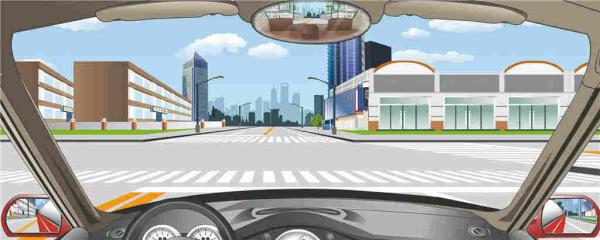
A. Slow down and pass
B. Speed up and pass
C. Sound the horn and pass
D. Stop immediately
Answer: A
16. How to ensure safe driving at night?
A. Drive at speed limit
B. Cut speed and drive carefully
C. Maintain the current speed
D. Drive above the speed limit
Answer: B
17. How to do in this situation?
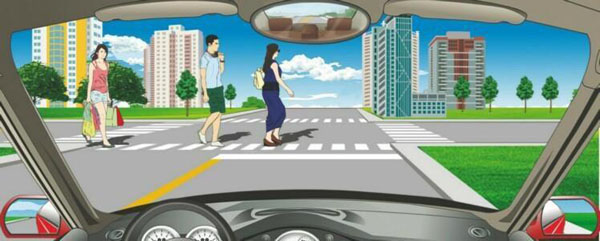
A. Stop and yield to the pedestrians
B. Bypass from the front of the pedestrians
C. Honk to remind the pedestrians
D. Bypass from the rear of the pedestrians
Answer: A
18. The main impact of rainy weather on safe driving is _______.
A. The visibility is poor
B. The tire grip decreases
C. The resistance to the vehicle increases
D. The road is wet and slippery
Answer: ABD
19. Having driven his vehicle at 110km/hour on an urban road, Mr. Lin is trying to leave the scene after a rear-end collision but is held back by bystanders. The alcohol concentration in his blood, tested in an alcohol test by the traffic police, is 135.8mg per hundred milliliters. Which of the following law-breaking acts did Mr. Lin commit?
A. Drunk driving
B. Speeding
C. Fatigued driving
D. Hit-and-run driving
Answer: ABD
20. What should the driver do to follow other motor vehicles on a mountain road?
A. Closely follow the vehicle in front
B. Increase the safety distance
C. Reduce the vertical distance between vehicles
D. Try to overtake the vehicle in front as soon as possible
Answer: B