

1. What is the meaning of this sign?

A. no entry for bicycles
B. lane for non-motorized vehicles
C. special lane for bicycles
D. bicycle stopping area
Answer: B
2. How should lamps be used when a motor vehicle meets an oncoming bicycle on a narrow road or a narrow bridge at night?
A. Continuously change between low-beam and high-beam
B. Use clearance lamp
C. Use high-beam
D. Use low-beam
Answer: D
3. What is the main impact of foggy weather on safe driving?
A. Easy to slide sideways
B. Low visibility
C. Increase the resistance
D. Widen the field of vision
Answer: B
4. A driver may drive a motorized vehicle after the driving license has been lost within 3 months.
A. Right
B. Wrong
Answer: B
5. When causing a road accident involving human casualties, the driver should immediately rescue the injured people and report to the traffic police as soon as possible.
A. Right
B. Wrong
Answer: A
6. When the driver discovers that steering is stiff, the wrong measure is to ___________.
A. Reduce speed and stop the vehicle as fast as possible
B. Stop at a safe place
C. Continue to drive
D. Identify the cause
Answer: C
7. It is not safe for a female driver to wear high heels to drive a vehicle.
A. Right
B. Wrong
Answer: A
8. If a motorized vehicle driver drives on the road after getting drunk is subject to a prison term of more than 3 years.
A. Right
B. Wrong
Answer: B
9. When passing a sharp curve, motor vehicle drivers may overtake if there are few other vehicles on the road.
A. Right
B. Wrong
Answer: B
10. When driving into the traffic flow on a main road from a relief road, drivers should speed up.
A. Right
B. Wrong
Answer: B
11. Driving and smoking has no negative effect on safe driving
A. Right
B. Wrong
Answer: B
12. What is the meaning of this sign?
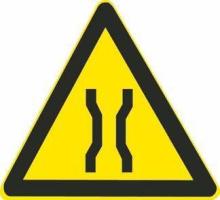
A. road narrows on the left side
B. narrow bridge
C. narrow road
D. road narrows on the right side
Answer: B
13. Traffic Police can detain the vehicle which is suspected of using other vehicle’s license plate and vehicle license.
A. Right
B. Wrong
Answer: A
14. How long is the period of probation after a motorized vehicle driver obtains his driving license for the first time or the permission to drive higher level vehicles.
A. 6 months
B. 12 months
C. 2 years
D. 3 months
Answer: B
15. What should the driver do when he/she encounters an oncoming ambulance in the same lane?
A. Keep to the side and reduce speed or stop to yield
B. Drive ahead by occupying another lane
C. Yield by speeding up and changing lanes
D. Drive ahead in the original lane
Answer: A
16. When running on the road having maximum speed limit signs, the motorized vehicle is not allowed to exceed the marked maximum speed.
A. Right
B. Wrong
Answer: A
17. If a person who has caused a major traffic accident and if his act constitutes a crime, he may not be held for criminal liabilities.
A. Right
B. Wrong
Answer: B
18. When a motorcycle goes down a long slope, it should run at a lower gear and fully use the engine to brake.
A. Right
B. Wrong
Answer: A
19. A motorized vehicle driver who escapes or commits other extremely serious acts after causing a major accident in violation of the traffic regulations is subject to a prison term of more than 7 years.
A. Right
B. Wrong
Answer: B
20. When a motor vehicle moves through water, the driver should try to maintain a constant speed and sufficient power and pass through without stopping.
A. Right
B. Wrong
Answer: A