

1. Traffic Police can detain the vehicle according to law if it is without the mandatory traffic accident insurance in accordance with state regulations.
A. Right
B. Wrong
Answer: A
2. When passing an intersection, vehicle motor drivers are not allowed to overtake.
A. Right
B. Wrong
Answer: A
3. The police can detain the vehicle if one drives a vehicle without ______
A. vehicle license
B. ID card
C. pass paper
D. qualification certificate
Answer: A
4. Which is subject to a 12-point penalty?
A. driving a motorized vehicle when driving license is temporarily detained
B. applying for reissuing the driving license by concealment or deception
C. not yielding to the school bus according to regulations
D. running with the license plate deliberately stained
Answer: D
5. A person who has taken the state-controlled psychiatric substances can drive motorized vehicle in short distance.
A. Right
B. Wrong
Answer: B
6. Which behavior a person had in 3 years is not allowed to apply for a motorized vehicle driving license?
A. insulin injections
B. drunken experience
C. smoking addiction
D. drug injections
Answer: D
7. A motorized vehicle driver who escapes or commits other extremely serious acts after causing a major accident in violation of the traffic regulations is subject to a prison term of more than 7 years.
A. Right
B. Wrong
Answer: B
8. If the accumulated penalty points of a motorized vehicle driver reach 12 points and the driver refuses to participate in the study course and also refuses to take tests, it should be publicly announced that his driving license should no longer be used.
A. Right
B. Wrong
Answer: A
9. When passing a turn or a curve section, the driver should slow down and disengage the clutch.
A. Right
B. Wrong
Answer: B
10. What is the meaning of this sign?
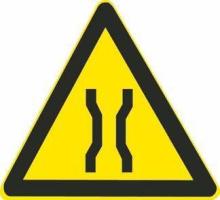
A. road narrows on the left side
B. narrow bridge
C. narrow road
D. road narrows on the right side
Answer: B
11. When a motor vehicle reaches a muddy or burst-and-muddy section of the road, the driver should stop, observe and select a level and solid section or a section with vehicle tracks.
A. Right
B. Wrong
Answer: A
12. If a motorized vehicle driver has caused a major accident in violation of the traffic regulations which has caused heavy loss to public or private property, the driver is subject to a prison term of less than 3 years or a criminal detention.
A. Right
B. Wrong
Answer: A
13. What should the driver do when encountering a vehicle from the opposite direction on a road without a central line?
A. driving closly by the roadside
B. driving by the central of the road
C. reducing speed and driving by right side
D. run by using the lane for non-motorized vehicles
Answer: C
14. What is the meaning of this sign?
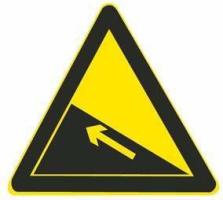
A. steep downhill road
B. continuous up slopes
C. steep uphill road
D. embankment road
Answer: C
15. How to do when causing a minor traffic accident with no human casualties and no dispute?
A. do not move the vehicle
B. counsel other vehicles bypass
C. leave the scene and discuss on their own
D. protect the scene and discuss
Answer: C
16. It is unsafe to ride a motorcycle by high-heel shoes.
A. Right
B. Wrong
Answer: A
17. What is the meaning of this sign?
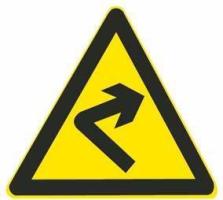
A. sharp right curve
B. bypass from right side
C. continuous curves
D. sharp left curve
Answer: A
18. When a tire blowout on the road, the driver should swiftly depress the brake pedal to reduce speed, do all his can to control the steering wheel and stop the vehicle as soon as possible.
A. Right
B. Wrong
Answer: B
19. When evading an emergency, except for being calm what principle should be held by drivers?
A. Evading people first and then objects
B. Evading objects first and then vehicles
C. Evading vehicles first and then people
D. Evading objects first and then people
Answer: A
20. When causing a road accident involving property damage, the party should leave the scene on his own but he does not leave, the traffic police can not order him to leave.
A. Right
B. Wrong
Answer: B