

1. A vehicle is not allowed to make a U turn on the ramp of an expressway.
A. Right
B. Wrong
Answer: A
2. As the road is wet and slippery after rain, brake application when driving can easily ___.
A. Cause sideways slide and traffic accident
B. Cause collision due to poor visibility
C. Be ignored by the drivers of other vehicles
D. Cause engine kill
Answer: A
3. Which is correct if a vehicle breaks down and is difficult to move?
A. turn on the hazard lights
B. turn on all the lights of the vehicle
C. forbid the passengers to get off
D. place a warning sign in front of the vehicle
Answer: A
4. When a vehicle passes a narrow road or bridge, it is prohibited from overtaking.
A. Right
B. Wrong
Answer: A
5. When causing a road accident involving property damage, the party should leave the scene on his own but he does not leave, the traffic police can not order him to leave.
A. Right
B. Wrong
Answer: B
6. It lights to indicate that ______

A. air internal circulation
B. air external circulation
C. the front fan works
D. windscreen defroster
Answer: B
7. Which should be carried onboard?
A. insurance policy
B. vehicle license
C. certificate of ex-factory inspection
D. vehicle registration papers
Answer: B
8. A motorized vehicle driver who drives after drinking is subject to a ________.
A. 3-point penalty
B. 2-point penalty
C. 6-point penalty
D. 12-point penalty
Answer: D
9. Besides the administrative punishment, what kind of system implemented by the traffic control department of the public security organ to the driver who violated the traffic regulations?
A. violation registration system
B. mileage reward system
C. mandatory write-off system
D. accumulated penalty points system
Answer: D
10. Whats the role of directional sign?
A. restrict the vehicles from passing
B. indicate speed limited information
C. provide direction information
D. warn danger ahead
Answer: C
11. When reaching a sharp curve, the driver should reduce speed and drive on the right side so as to avoid colliding with the vehicle crossing the central line of the curve in the opposite direction.
A. Right
B. Wrong
Answer: A
12. A small bus driver should reduce speed rapidly when he suddenly feel bumpy on a flat expressway, to prevent tire blowout.
A. Right
B. Wrong
Answer: A
13. If a person who has caused a major traffic accident and if his act constitutes a crime, he may not be held for criminal liabilities.
A. Right
B. Wrong
Answer: B
14. When passing through an overflowing road, a high gear should be used to pass rapidly.
A. Right
B. Wrong
Answer: B
15. This set of the hand signals of the traffic police indicates that the vehicles should ____ .

A. turn right
B. change lane
C. reduce speed and pass slowly
D. pull over
Answer: C
16. What kind of violation does this vehicle on road have?
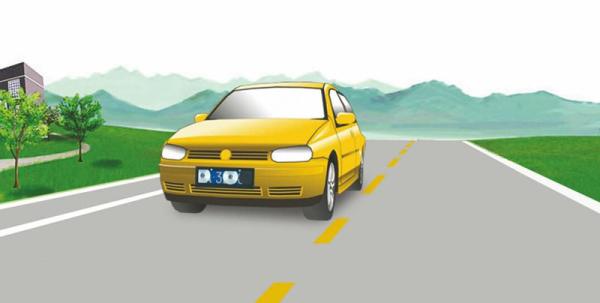
A. not hang the license plate as required
B. deliberately cover the license plate
C. occupy the lane for non-motorized vehicles
D. run in the opposite direction
Answer: B
17. What kind of marking is the yellow broken line in the center of the road?
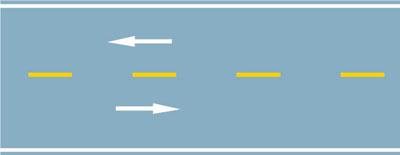
A. indicative marking
B. prohibitive marking
C. warning sign
D. auxiliary marking
Answer: A
18. If the drivers accumulated penalty points reach the stipulated limit, he will be _______ by the traffic control department of the public security organ.
A. detained for less than 15 days
B. banned for lifetime from driving
C. educated on the law and regulations and take the exam again
D. held for criminal liabilities according to law
Answer: C
19. Whats the meaning of this sign?
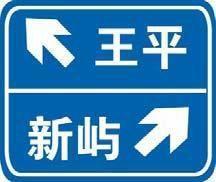
A. ring intersection ahead
B. intersection ahead
C. Y-shaped intersection ahead
D. T-shaped intersection ahead
Answer: C
20. Whats the role of the indicative marking?
A. No passing
B. indicate vehicles to pass
C. restrict from passing
D. warn and remind
Answer: B