

1. How to do when the vehicle breaks down on road and needs to stop to solve the problem?
A. stop in the middle of the road
B. stop the vehicle where will not interfere the traffc
C. turn on the low beam lights or fog lights
D. stop on the spot to solve the problem
Answer: B
2. A light motorcycle is only permitted to carry preschoolers.
A. Right
B. Wrong
Answer: B
3. What is the meaning of this sign?
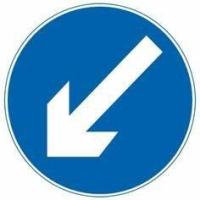
A. stop by the left side of the road
B. downhill section left
C. left turn only
D. run by the left side of the road
Answer: D
4. When approaching a vehicle on a narrow slope, which one of the following ways is correct?
A. The descending vehicle yields to the ascending
B. The vehicle which is further from the slope crest should yield
C. The ascending vehicle yields to the descending
D. If the descending vehicle has reached the midpoint while the ascending vehicle has not yet set out, the descending vehicle must yield.
Answer: A
5. According to regulations, motorcycle driver should wear _______.
A. Glasses
B. A special safety helmet
C. Gloves
D. Safety kneepads
Answer: B
6. After setting off from the roadside, motor vehicle drivers should speed up as soon as possible and make a sharp left-turn in order to drive into the normal lane.
A. Right
B. Wrong
Answer: B
7. When driving a motorized vehicle uphill, you should speed up and honk when you going to reach the top of the slope.
A. Right
B. Wrong
Answer: B
8. A motorized vehicle driver who escapes or commits other extremely serious acts after causing a major accident in violation of the traffic regulations is subject to a prison term of more than 7 years.
A. Right
B. Wrong
Answer: B
9. What is the meaning of this sign?

A. slippery section
B. sharp curve
C. inverse curve
D. continuous curves
Answer: C
10. A motorized vehicle driver who uses falsified and altered license plate is subject to a ________.
A. 2-point penalty
B. 3-point penalty
C. 12-point penalty
D. 6-point penalty
Answer: C
11. It is unsafe to ride a motorcycle by high-heel shoes.
A. Right
B. Wrong
Answer: A
12. In which situation the traffic police can detain the vehicle according to law?
A. exceeding 10% of the prescribed speed limits
B. driving wen he is exhausted
C. not buckled up while driving
D. driving after drinking
Answer: D
13. Serious wave will appear when the front tire blows out; the driver should release the accelerator, firmly hold the steering wheel with both hands, quickly gradually break down, and stop to yield.
A. Right
B. Wrong
Answer: A
14. In which section when a vehicle runs is prohibited from overtaking.
A. elevated road
B. intersection
C. central streets
D. ring express
Answer: B
15. When a motorcycle goes down a long slope, it should run at a lower gear and fully use the engine to brake.
A. Right
B. Wrong
Answer: A
16. The wrong measure to use the brake of a motorcycle is to __________.
A. Simultaneously use the front and back brakes
B. Use the front brake first
C. Use the back brake first
D. Avoid using the front brake too early
Answer: B
17. How to drive through the intersection without traffic lights?
A. reduce speed and go slowly
B. speed up and pass
C. let large vehicle go first
D. let the left vehicle go first
Answer: A
18. When a motor vehicle moves through water, the driver should try to maintain a constant speed and sufficient power and pass through without stopping.
A. Right
B. Wrong
Answer: A
19. When a tire blowout on the road, the driver should control the direction of the vehicle and use emergency braking to bring the vehicle swiftly to a stop.
A. Right
B. Wrong
Answer: B
20. When driving, besides paying attention to keeping a safe distance from the vehicle in front, drivers should also be prudent when braking so as to avoid a rear-end collision caused by a vehicle behind.
A. Right
B. Wrong
Answer: A