

1. If a driver has not received full penalty points, and the fine has not been paid, the penalty points will be transferred into the next scoring cycle.
A. Right
B. Wrong
Answer: A
2. It lights to remind that engine oil needs to be filled.

A. Right
B. Wrong
Answer: B
3. A person who falsifies, alters driving license or uses falsified, altered driving license, and if his act constitutes a crime, he should be held for criminal liabilities according to law.
A. Right
B. Wrong
Answer: A
4. When passing a dangerous section of a mountain road, especially by the locations of frequent occurrence of landslides, mudslides, the driver should drive with care and avoid stopping.
A. Right
B. Wrong
Answer: A
5. This sign indicates indoor car park here.
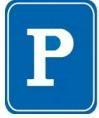
A. Right
B. Wrong
Answer: B
6. The front safety bags play a fully protective role when used in conjunction with ______
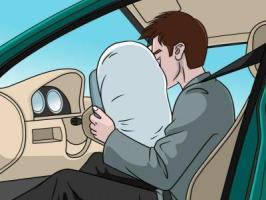
A. ABS system
B. seat belt
C. safety pillow of the chair
D. safety glasses
Answer: B
7. Full penalty points of a scoring cycle because of violating the traffic regulations is 12 points.
A. Right
B. Wrong
Answer: A
8. When passing an intersection without traffic lights, the driver should go through as fast as possible.
A. Right
B. Wrong
Answer: B
9. A vehicle is not allowed to make a U turn on the ramp of an expressway.
A. Right
B. Wrong
Answer: A
10. When a motorized vehicle passes through narrow road or bridge, the maximum speed should not exceed 30 kilometers per hour.
A. Right
B. Wrong
Answer: A
11. Within the validity of the Admission Form, the times of test reservation for Driving Skills of subject 2 and subject 3 can not exceed ______
A. 3 times
B. 4 times
C. 5 times
D. 6 times
Answer: C
12. What kind of violation does the red car have while temporarily stopping here?
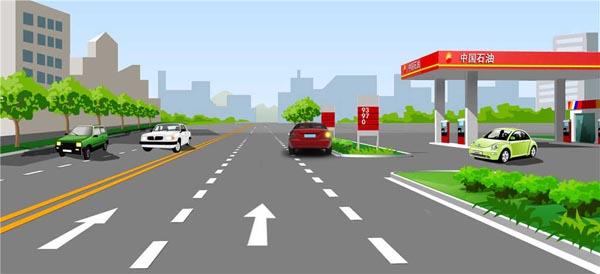
A. more than 30cm from roadside
B. stop in the section with no stopping marking
C. less than 30m from gas station
D. stop occupying the lane for non-motorized vehicles
Answer: C
13. If the drivers household register has moved out of the original vehicle management station, the driver should apply to the vehicle management station _______ .
A. At the former place of his household register
B. At the residential place
C. At the new place of his household register
D. At the location of his household register
Answer: C
14. When encountering a traffic jam on the expressway, the driver should follow the front vehicle lining up, and immediately turn on the hazard light to prevent rear-end collision.
A. Right
B. Wrong
Answer: A
15. Whats the meaning of this sign?
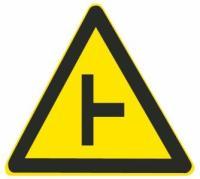
A. Y-shaped intersection
B. T-shaped intersection
C. intersection
D. ring intersection
Answer: B
16. A driver should drive the vehicles in accordance with the qualification listed on the driving license.
A. Right
B. Wrong
Answer: A
17. Whats the meaning of the white broken line by the carriage on the right side road?
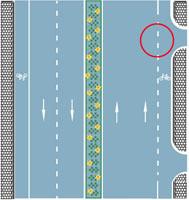
A. allowed to temporarily cross
B. prohibited from crossing
C. emergency lanes dividing line
D. crosswalk dividing line
Answer: A
18. One who runs away after causing a traffic accident and constitute a crime can not apply for motorized vehicle driving license.
A. Right
B. Wrong
Answer: A
19. The driving license will be revoked when the person is executed community drug treatment, forced isolation treatment or community-based rehabilitation measures.
A. Right
B. Wrong
Answer: A
20. Traffic Police can detain the vehicle according to law if it runs on the road failing to place a label of inspection.
A. Right
B. Wrong
Answer: A