

1. It lights to indicate that engine oil may be insufficient.

A. Right
B. Wrong
Answer: A
2. When the driver discovers a tire is leaking and steers the vehicle off the main carriageway, he should refrain from applying emergency so as to avoid a vehicle turnover or a rear-end collision arising from the late braking of the following vehicle.
A. Right
B. Wrong
Answer: A
3. The driving license of 10-year validity will be issued if the penalty points never reached 12 points in every scoring cycle during the 6-year validity of the license.
A. Right
B. Wrong
Answer: A
4. When encountering a traffic accident ahead and help is needed while driving, the driver should ________.
A. Bypass to dodge it as much as possible
B. Immediately report to the police, stop and look on.
C. Help to preserve the scene and immediately report to the police
D. Speed up and pass to ignore it
Answer: C
5. When driving in a snowy day, the driver should drive along the vehicle tracks if there are any.
A. Right
B. Wrong
Answer: A
6. A person who has taken the state-controlled psychiatric substances can drive motorized vehicle in short distance.
A. Right
B. Wrong
Answer: B
7. When passing through an overflowing road, a high gear should be used to pass rapidly.
A. Right
B. Wrong
Answer: B
8. What kind of marking are the double yellow solid lines in the middle of the road?
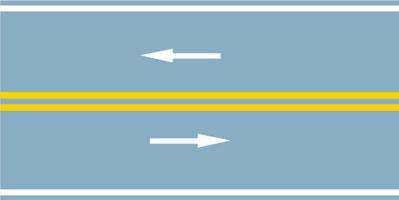
A. auxiliary marking
B. warning sign
C. prohibitive marking
D. indicative marking
Answer: C
9. Whats the meaning of this sign?
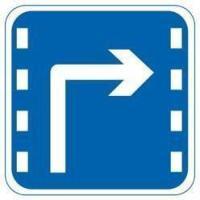
A. right-turn lane
B. U turn lane
C. left-turn lane
D. lanes for going in different directions
Answer: A
10. What is this manipulation device?
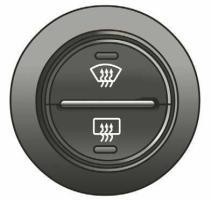
A. switch of the turn signal
B. switch of the head lights
C. switch of wiper
D. switch of defogger
Answer: D
11. No U turn at this section.

A. Right
B. Wrong
Answer: B
12. A motorized vehicle runs on the road without a label of inspection, the traffic police can detain the vehicle.
A. Right
B. Wrong
Answer: A
13. Whats the meaning of this sign?
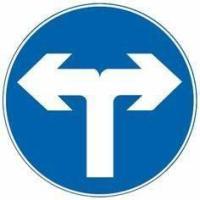
A. no left turn
B. left and right turn
C. no left and right turn
D. no right turn
Answer: B
14. In this case, if it has not begun going up the slope, the vehicle going uphill should yield to the one going downhill.
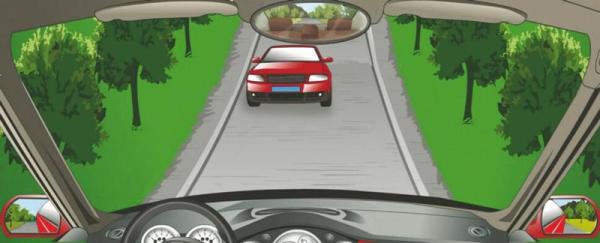
A. Right
B. Wrong
Answer: A
15. How to do in this situation?

A. stop and yield to the pedestrians
B. bypass from the front of the pedestrians
C. honk to remind the pedestrians
D. bypass from the rear of the pedestrians
Answer: A
16. What kind of lane that the red car running in?
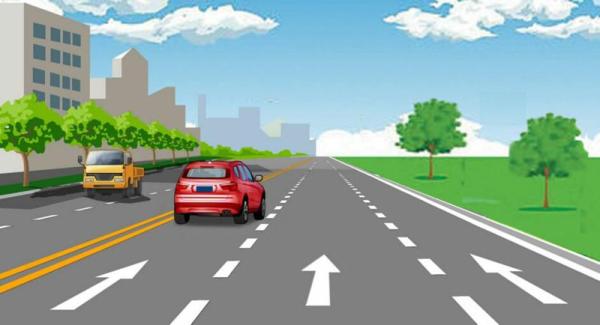
A. fast lane
B. slow lane
C. emergency lane
D. special lane
Answer: A
17. Whats the meaning of this sign?

A. an unmanned level crossing 100m ahead
B. a manned level crossing 100m ahead
C. an unmanned level crossing 50m ahead
D. a manned level crossing 50m ahead
Answer: C
18. When driving on a mountain road covered by ice and snow, the vehicle behind should ______ if the vehicle in front is climbing a slope.
A. Climb slowly
B. Closely follow and climb
C. Select a proper place to stop and climb after the vehicle in front has passed
D. Rapidly overtake the vehicle in front
Answer: C
19. It is not safe for a woman driver to wear high heels to drive a vehicle.
A. Right
B. Wrong
Answer: A
20. What is this traffic sign?
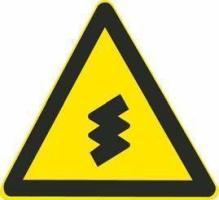
A. slippery section
B. sharp curve
C. inverse curve
D. continuous curves
Answer: D