

1. When finding a vehicle in the opposite direction having difficulty to go forward and needing to borrow road while crossing each other, the driver should ________.
A. Not occupy the road of the other side and should go forward normally
B. Indicate the other side to stop and yield
C. Speed up and go forward by the right side
D. Yield to the other side as much as possible
Answer: D
2. At this position, you may speed up to pass through the section.
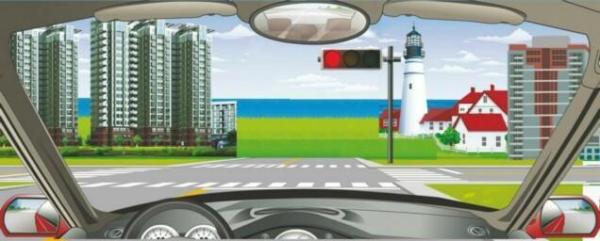
A. Right
B. Wrong
Answer: B
3. When driving in a snowy day, the driver should drive along the vehicle tracks if there are any.
A. Right
B. Wrong
Answer: A
4. This sign reminds the width of the bridge narrows ahead.
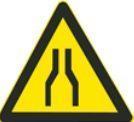
A. Right
B. Wrong
Answer: B
5. When a vehicles turns, it should do so on the right side and refrain from occupying the lane of the other party. The left turn should be gentle and the right turn should be sharp.
A. Right
B. Wrong
Answer: A
6. Whats the meaning of this sign?
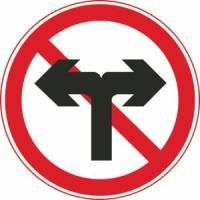
A. no U turn at intersection
B. no changing lane from both sides
C. no left or right turn
D. no going straight
Answer: C
7. How to cross each other on a narrow mountain road without the central dividing line?
A. The vehicle not close to the mountain goes first
B. The vehicle close to the mountain goes first
C. The empty vehicle goes first
D. The slow-moving vehicle goes first
Answer: A
8. When a vehicle goes down a long slope, it should run at a lower gear and fully use the engine to brake.
A. Right
B. Wrong
Answer: A
9. When a vehicle follows another vehicle on a mountain road, it should ____.
A. Properly increase the safe distance
B. Closely follow the vehicle in front
C. Properly reduce the safe distance
D. Try to find a chance to overtake
Answer: A
10. When encountering non-motorized vehicles intending to bypass a stopping vehicle, the driver should ________.
A. Honk to indicate them to yield
B. Yield to them
C. Speed up and bypass
D. Follow them closely and honk
Answer: B
11. This sign indicates running slowly or stopping to let the vehicle on main road go first.
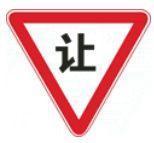
A. Right
B. Wrong
Answer: A
12. A motorized vehicle driver is not allowed during the period of probation to pull a trailer.
A. Right
B. Wrong
Answer: A
13. Whats the meaning of this sign?
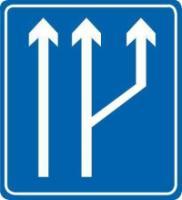
A. change to right lane
B. branching point
C. road surface becomes wider
D. the number of lanes increases
Answer: D
14. When overtaking, the driver should try his best to increase the horizontal distance and,when necessary, may cross the solid line to overtake.
A. Right
B. Wrong
Answer: B
15. A motorized vehicle that will turn right at an intersection but has a vehicle in front in the same lane waiting for the green light should ______________.
A. Stop and wait for his turn
B. Honk to indicate the vehicle in front to yield
C. Bypass the vehicle in front from the right side and go through the intersection
D. Bypass the vehicle in front from the left side and go through the intersection
Answer: A
16. Nobody is allowed to drive a motorized vehicle that has safety hazards.
A. Right
B. Wrong
Answer: A
17. A motorized vehicle driver who drives more than 50% faster than the prescribed speed limit is subject to a 12-point penalty.
A. Right
B. Wrong
Answer: A
18. The vehicle is allowed to _______ at this intersection.

A. go straight
B. turn right
C. turn left
D. go straight or turn left
Answer: B
19. What to do besides controlling speed less than 20km/hr when the visibility is lower than 50 meters on the expressway?
A. run in the emergency lane
B. leave the expressway as soon as possible
C. stop by the roadside as soon as possible
D. run slowly in the road shoulder
Answer: B
20. In the course of making a U turn, the driver should strictly control the speed, carefully observe the road conditions before and behind the vehicle, and may advance or reverse only if it is safe to do so.
A. Right
B. Wrong
Answer: A