

1. When encountering this situation around a school, the driver should speed up and pass as quickly as possible.

A. Right
B. Wrong
Answer: B
2. The broken white line rectangle area on the right side of the road indicates that long stopping is permitted here.
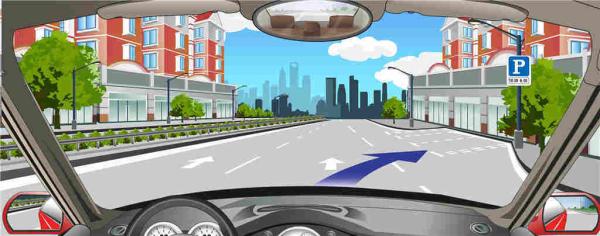
A. Right
B. Wrong
Answer: B
3. Under such circumstances, the driver should stop the vehicle and yield to pedestrians.

A. Right
B. Wrong
Answer: A
4. The area in the yellow rectangle markings on the right side of the road indicates that temporary stopping is permitted here.
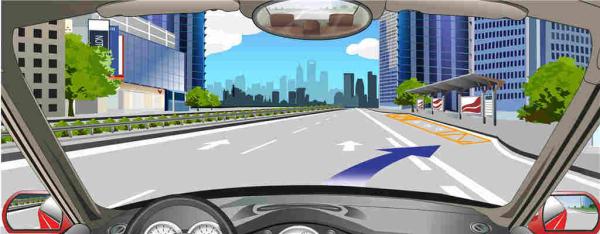
A. Right
B. Wrong
Answer: B
5. When a motor vehicle stops temporarily in a rainy day,which lamp should be turned on?
A. Front and rear fog lamps
B. Hazard lamps
C. Headlamps
D. Reverse lamps
Answer: B
6. When encountering an emergency on a highway, the driver should not drastically turn to evade.
A. Right
B. Wrong
Answer: A
7. The driver should turn left by the left side of the intersection central point.
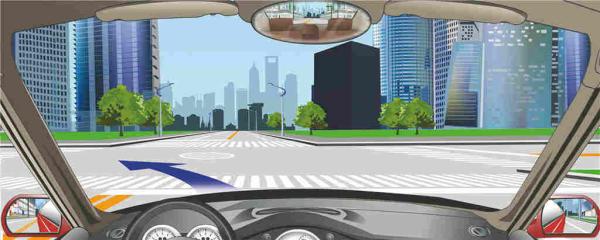
A. Right
B. Wrong
Answer: A
8. How should the driver use vehicle lights when the motor vehicle leaves a roundabout?
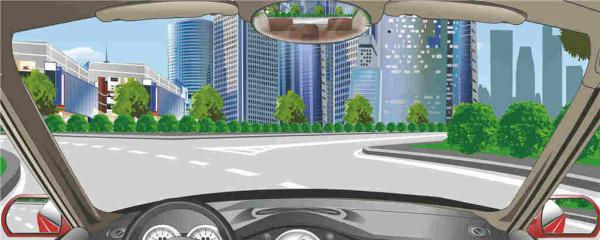
A. Turn on the left-turn indicator
B. Turn on the hazard lamps
C. No need to turn on any indicators
D. Turn on the right-turn indicator
Answer: D
9. Drivers may turn left when seeing these hand signals.
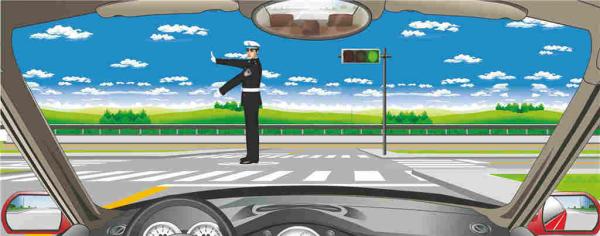
A. Right
B. Wrong
Answer: A
10. When driving in a strong wind, drivers should abruptly turn the steering wheel to return to the original direction if they feel the vehicle deviates horizontally due to a strong gale.
A. Right
B. Wrong
Answer: B
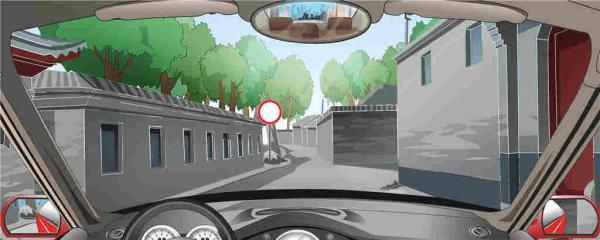
11. vehicles may stop temporarily in this area.
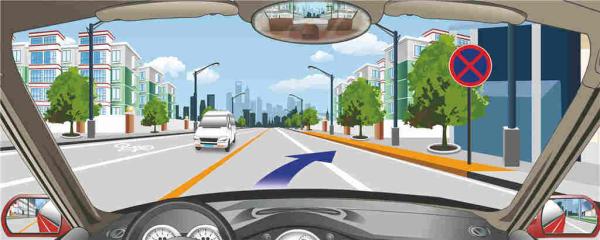
A. Right
B. Wrong
Answer: B
12. When encountering a school bus which stops at the right roadside and students are embarking or disembarking, and there are two motor vehicle lanes in each direction, motor vehicle drivers on the left lane behind the bus should stop and wait.
A. Right
B. Wrong
Answer: A
13. When a motor vehicle deviates from the normal direction due to steering failure and an accident is unavoidable, what should the driver do?
A. Apply emergency brake
B. Immediately steer and adjust
C. Immediately steer to the side where there is no obstacle and evade
D. Immediately steer to the side where there is an obstacle and evade
Answer: A
14. Mr. Qi drove a large bus with 28 passengers (capacity 55 people). When arriving at an intersection without any traffic signals from south to north at a speed of 50 kilometers per hour, the bus had a side collision with Mr. Li?ˉs heavy semi-trailer tractor (capacity 40 tons and carrying 55.2 tons) running from east to west. As a result of this accident, 12 people were killed and 17 injured. What are the main illegal acts in this case?
A. The bus carried more passengers than capacity
B. The bus exceeded the speed limit
C. The tractor carried more cargo than capacity
D. The driver of the tractor was inexperienced
Answer: BC
15. When a bus encounters an unexpected situation or an accident, the driver should do his best to minimize the loss and should never cause a secondary accident or even greater loss for the sake of avoiding danger.
A. Right
B. Wrong
Answer: A
16. The sign on the right warns of an uneven road ahead.
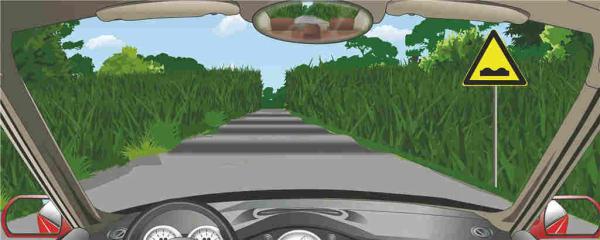
A. Right
B. Wrong
Answer: A
17. When such circumstances happen suddenly, what should the driver do?

A. Reduce speed or stop to yield
B. Bypass in front of the pedestrians
C. Continuously sound the horn to alert the pedestrians
D. Bypass from behind the pedestrians
Answer: A
18. What is the best way to make turns on this kind of curving mountain road?
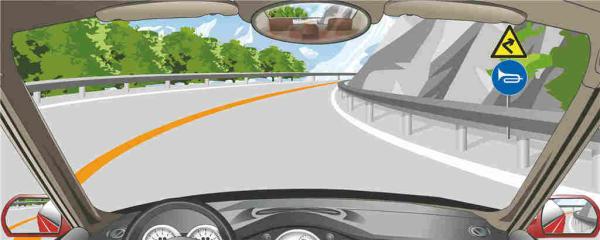
A. Drive along the outer side of the curve
B. Slow down, sound the horn and drive on the right
C. Borrow the opposite lane
D. Drive along the central line of the road
Answer: B
19. Where is the proper parking place for motor vehicles driving on an expressway?
A. On the expressway ramp
B. In the acceleration lane
C. In the deceleration lane
D. In a service area
Answer: D
20. The sign on the left indicates vehicles are allowed to drive on the section ahead.
A. Right
B. Wrong
Answer: B