

1. If a fast moving vehicle has a steering failure, using emergency braking can easily cause an overturn.
A. Right
B. Wrong
Answer: A
2. When rescuing a wounded person who has been poisoned by toxic gas, which of the following measures should be taken first?
A. Prevent heat loss
B. Bring him to a place with fresh air
C. Give him artificial respiration
D. Depress the heart over the chest
Answer: B
3. Motor vehicle drivers may make a U-turn in the broken line area as long as it will not affect the normal traffic flow.
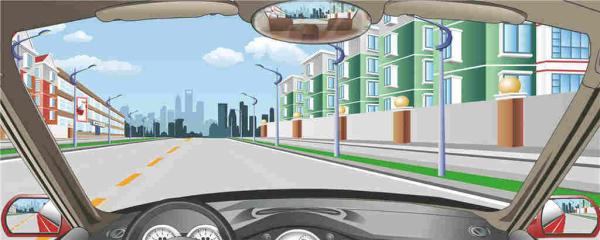
A. Right
B. Wrong
Answer: A
4. Which of the following is a bad driving habit?
A. Using lights in accordance with relevant rules
B. Carrying both vehicle and driving license
C. Discarding rubbish from the side window
D. Follow the guidance of the traffic signals
Answer: C
5. The sign on the right indicates to stop and yield at the intersection ahead.
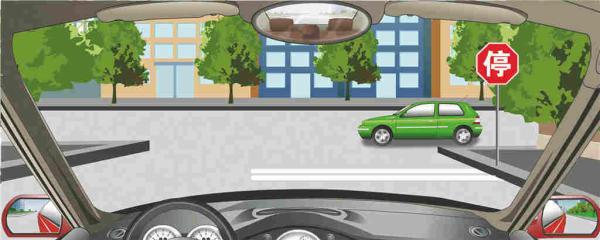
A. Right
B. Wrong
Answer: A
6. When a motor vehicle breaks down on a mountain road, what should the driver do?
A. Park on a downhill section
B. Park on an uphill section
C. Park on a gentle section of the mountain road
D. Park on the crest of a slope
Answer: C
7. The sign on the right indicates a T-shaped intersection head.
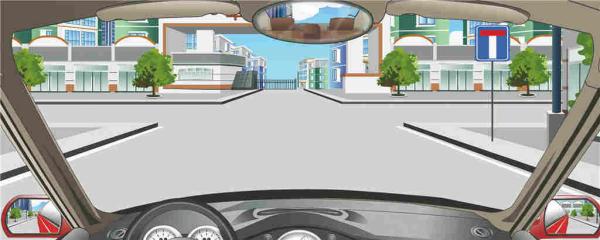
A. Right
B. Wrong
Answer: B
8. Under such circumstances, motor vehicle drivers should bypass on the left quickly.

A. Right
B. Wrong
Answer: B
9. After setting off from the roadside, motor vehicle drivers should speed up as soon as possible and make a sharp left-turn in order to drive into the normal lane.
A. Right
B. Wrong
Answer: B
10. After speeding up to more than 60 km/hour, a motor vehicle driver may drive onto the driving lane directly.
A. Right
B. Wrong
Answer: B
11. The sign on the right warns of a danger from rockfall on the left side.
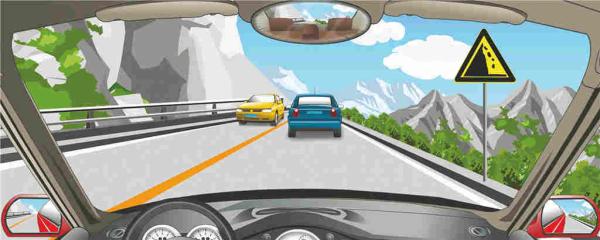
A. Right
B. Wrong
Answer: A
12. Dangerous chemicals possess the characteristics of explosion, inflammation, poison, erosion and radiation.
A. Right
B. Wrong
Answer: A
13. Two parallel broken double-yellow lines indicate the position of a diversion lane.
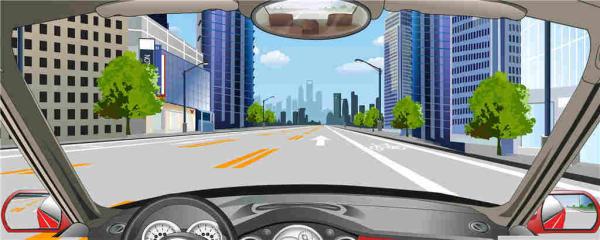
A. Right
B. Wrong
Answer: A
14. Once inflammable gas causes a fire disaster, it should be put out with water in good time.
A. Right
B. Wrong
Answer: B
15. The main impact of muddy roads on safe driving is that the wheels may easily spin and skid
A. Right
B. Wrong
Answer: A
16. Mr. Ran drove his car from 6am until 11 am without rest, falling down a steep 8.5-meter ridge at one side of a highway 1 km from Xunan Road in Xuahan County, killing 13 people and injuring 9. Which of the following law-breaking acts did Mr Ran commit?
A. Speeding
B. Driving not in accordance with the traffic markings
C. Exceeding carrying capacity
D. Fatigued driving
Answer: D
17. The sign on the right warns of a winding road to the left ahead.
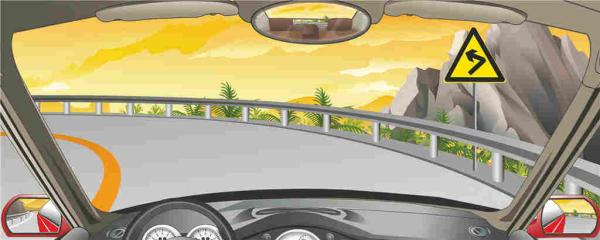
A. Right
B. Wrong
Answer: B
18. If a motor vehicle encounters a strong side wind when it leaves the opening of an expressway tunnel, what will happen?
A. A feeling of deceleration
B. A feeling of acceleration
C. A feeling of pressure
D. Deviation in direction
Answer: D
19. When the vehicle engine catches fire, what should the driver do first?
A. Turn off the engine as soon as possible
B. Extinguish the fire with water
C. Open the hood to extinguish the fire
D. Extinguish the fire from the leeward direction
Answer: A
20. Under such circumstances, what should motor vehicle drivers do?
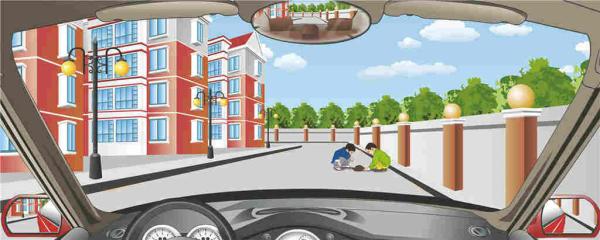
A. Continuously sound the horn
B. Pass quickly
C. Pass at a lower speed
D. Bypass from either side
Answer: C