

1. When driving on a foggy day, the driver should turn on the fog lamp.
A. Right
B. Wrong
Answer: A
2. What is the meaning of this sign?

A. turn right
B. one-way road
C. going straight only
D. straight-going lane
Answer: A
3. If the accumulated penalty points of a motorized vehicle driver reach 12 points and the driver refuses to participate in the study course and also refuses to take tests, it should be publicly announced that his driving license should no longer be used.
A. Right
B. Wrong
Answer: A
4. What is the meaning of this sign?
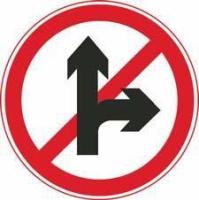
A. no going straight and no changing to left lane
B. no going straight and no left turn
C. allowed to go straight and change to left lane
D. no going straight and no right turn
Answer: D
5. A motorized vehicle is not allowed to stop in the section 50 meters to the intersection.
A. Right
B. Wrong
Answer: A
6. What is the meaning of this sign?

A. customs inspection
B. stop-for-inspection
C. frontier inspection
D. no passing
Answer: B
7. If a motorized vehicle driver allows his vehicle to be driven by a person whose driving license has been revoked, the traffic police will detain the driving license.
A. Right
B. Wrong
Answer: A
8. Illegally assembled motorized vehicle can be drived on road as long as it is thought to be safe.
A. Right
B. Wrong
Answer: B
9. When passing a sharp curve, motor vehicle drivers may overtake if there are few other vehicles on the road.
A. Right
B. Wrong
Answer: B
10. When use the brake of a motorcycle, use the front-wheel brake first, then use the back-wheel brake.
A. Right
B. Wrong
Answer: B
11. Nobody is allowed to drive a motorized vehicle that has safety hazards.
A. Right
B. Wrong
Answer: A
12. Traffic Police can detain the vehicle according to law if it is without the mandatory traffic accident insurance in accordance with state regulations.
A. Right
B. Wrong
Answer: A
13. The behavior of a motorized vehicle driver who has violated the law and regulations on road traffic safety is _______ .
A. faulty act
B. violation of regulations
C. rule-breaking act
D. violation of law
Answer: D
14. Which behavior a person had in 3 years is not allowed to apply for a motorized vehicle driving license?
A. insulin injections
B. drunken experience
C. smoking addiction
D. drug injections
Answer: D
15. What should be done by the driver who intends to overtake but finds that the vehicle in front is also overtaking?
A. Following the vehicle in front closely and finding a chance to overtake it
B. Accelerating to overtake forcefully
C. Continuously sounding the horn to urge the vehicle in front to yield
D. Refraining from overtaking and letting the vehicle in front overtake first
Answer: D
16. When a motorcycle goes downhill on a mountain road, it is not allowed to overtake.
A. Right
B. Wrong
Answer: A
17. Which of the following measures is incorrect when a motor vehicle stops?
A. Stop at a stipulated place
B. Avoid stopping on pedestrian streets
C. Avoid obstructing the passing of other motor vehicles and pedestrians when temporarily stops on the road
D. Stop on the non-motor vehicle lane
Answer: D
18. If the vehicle has no license plate, label of inspection or label of insurance, preserve the scene and immediately report to the police.
A. Right
B. Wrong
Answer: A
19. When the driver discovers a tire is leaking and steers the vehicle off the main carriageway, he should refrain from applying emergency so as to avoid a vehicle turnover or a rear-end collision arising from the late braking of the following vehicle.
A. Right
B. Wrong
Answer: A
20. What is the meaning of this sign?

A. no right turn
B. no U turn
C. no going straight
D. no left turn
Answer: C