

1. What should drivers keep in mind when driving on a mountainous road?
A. Keep a safe distance
B. Avoid occupancy of another lane when making a turn
C. Downshift in advance when ascending an abrupt slope
D. Taking full advantage of engine braking when descending a long slope
Answer: ABCD
2. When parking temporarily in this situation, motor vehicle drivers are allowed to turn the steering wheel left to avoid sliding.

A. Right
B. Wrong
Answer: A
3. The right-front sign indicates a time-regulated pedestrian area.
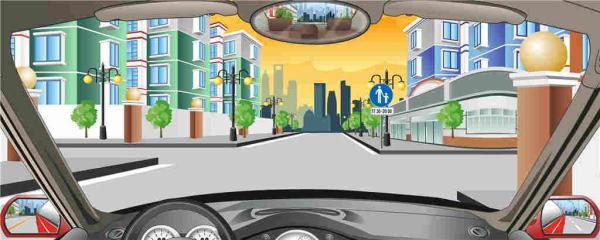
A. Right
B. Wrong
Answer: A
4. The sign on the right warns of a wildlife protection area ahead.
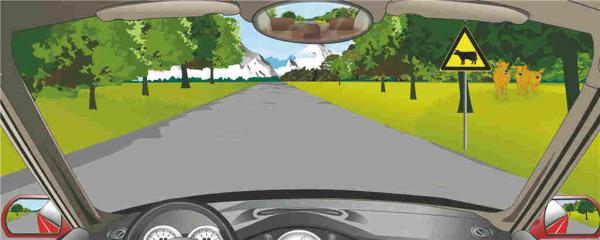
A. Right
B. Wrong
Answer: B
5. The road marker indicates that vehicles are only allowed to turn right at the intersection ahead.
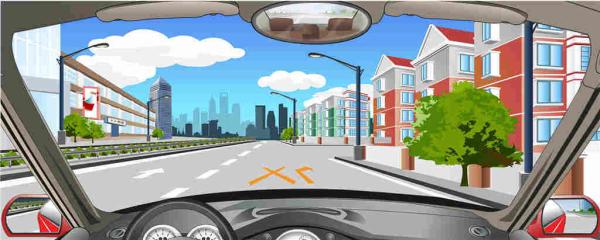
A. Right
B. Wrong
Answer: B
6. When the driver discovers a tire is leaking and steers the vehicle off the main driving lane, he/she should refrain from applying emergency braking so as to avoid a vehicle turnover or a rear-end collision arising from the late braking of the vehicle behind.
A. Right
B. Wrong
Answer: A
7. Which of the following is a basic requirement for rescuing the injured at the scene of a traffic accident?
A. Treat wounds first and safe life later
B. Save life first and treat wounds later
C. Help lightly wounded persons first
D. Help seriously wounded persons later
Answer: B
8. When the engine suddenly stalls on the road and cannot be restarted, the driver should pull over in a timely fashion and identify the cause of the stalling.
A. Right
B. Wrong
Answer: A
9. The white zig-zag line on the highway serves as a reference for the speed of a driver.
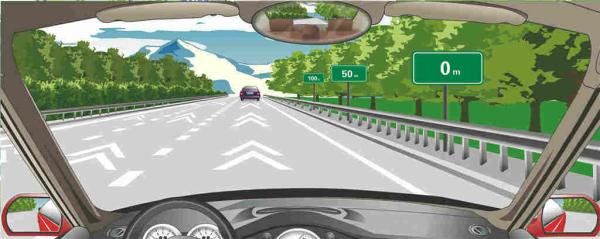
A. Right
B. Wrong
Answer: B
10. When a wounded person suffering bone fracture in the thigh, shank or spine, moving the wounded person is usually prohibited.
A. Right
B. Wrong
Answer: A
11. Motor vehicle drivers may borrow a special lane for other vehicle types, if one exists, to overtake.
A. Right
B. Wrong
Answer: B
12. Motor vehicle drivers don?ˉt need to fasten their seatbelt
A. Right
B. Wrong
Answer: B
13. Mr. Zou drove a large sleeper coach (capacity 35 people and carrying 47 passengers). At the spot of 938 kilometers of the Jinggang ao Expressway, large amounts of dangerous chemicals in the coach blew up, killing 41 people and injuring 6. What are the main illegal acts in this case?
A. Carrying more passengers than permitted
B. Passengers carried flammable and explosive substances
C. Speeding
D. Illegal parking
Answer: AB
14. Which of the following is a safe way for motor vehicles to pass the intersection marked with this sign?
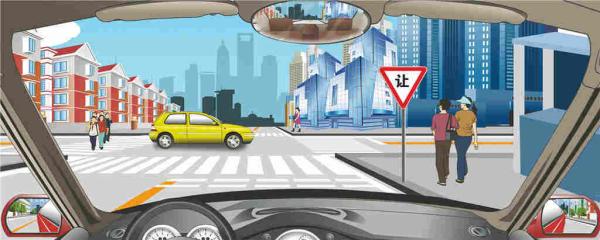
A. Stop and observe the traffic situation around the intersection
B. Approach the intersection by speeding up
C. Observe the traffic situation on the left rear side
D. Approach the intersection at a reduced speed
Answer: D
15. When a motor vehicle slides sideways, how should the driver adjust the direction?
A. If the front wheels skid sideways, turn the steering wheel in the direction of the skid
B. If the front wheels skid sideways, turn the steering wheel in the opposite direction of the skid
C. If the rear wheels skid sideways, turn the steering wheel in the direction of the skid
D. If the rear wheels skid sideways, turn the steering wheel in the opposite direction of the skid
Answer: BC
16. When removing a wounded person suffering spinal fracture, the rescuer should never help the wounded person to walk. He may be carried away with a soft stretcher.
A. Right
B. Wrong
Answer: B
17. When driving a motor vehicle equipped with power steering, the driver should firmly hold the steering wheel and drive slowly if he suddenly finds that steering is difficult.
A. Right
B. Wrong
Answer: B
18. Under such circumstances, what should be done by the motor vehicle driver?

A. Overtaking the vehicle in front on its left
B. Overtaking by occupying the opposite lane
C. Overtaking the vehicle in front on its right
D. Following the vehicle in front
Answer: D
19. This sign warns to bypass from the left side to avoid the roadblock.
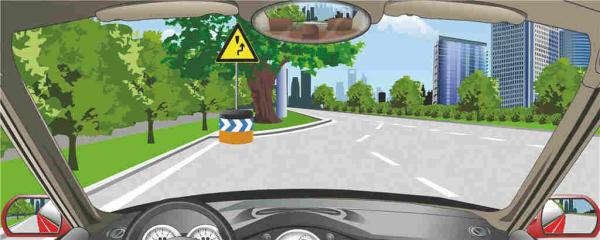
A. Right
B. Wrong
Answer: B
20. What should the driver do in this condition?

A. Go through normally on the right side
B. Sound the horn and speed up to go through the tunnel
C. Stop and yield to the oncoming vehicle
D. Turn on the headlamp to warn the oncoming vehicle to yield
Answer: C