

1. What is the meaning of this sign?
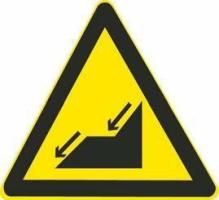
A. continuous down slopes
B. steep downhill road
C. steep uphill road
D. continuous up slopes
Answer: A
2. What is the meaning of this sign?

A. turn right
B. one-way road
C. going straight only
D. straight-going lane
Answer: A
3. What is the meaning of this sign?
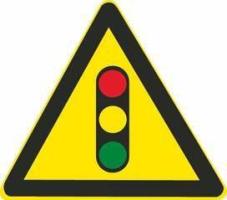
A. crosswalk lights
B. watch for pedestrians
C. attention to traffic lights
D. intersection
Answer: C
4. Which lamp should be turned on when motor vehicles pass through a road section at night where the street light condition is good?
A. Front and rear fog lamps
B. Low-beam
C. High-beam
D. Hazard lamp
Answer: B
5. After causing a road accident, the vehicle driver needs to change the scene for rescuing the wounded, the driver should mark the location.
A. Right
B. Wrong
Answer: A
6. What is the meaning of this sign?
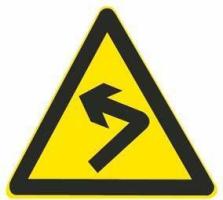
A. bypass from left side
B. continuous curves
C. sharp left curve
D. sharp right curve
Answer: C
7. In which situation the traffic police may detain the vehicle?
A. no vehicle registration papers
B. no insurance contract
C. no lable of environmental protection
D. no label of insurance
Answer: D
8. When a motorcycle goes downhill on a mountain road, it is not allowed to overtake.
A. Right
B. Wrong
Answer: A
9. How to pass through the unmanned level crossing without traffic lights?
A. properly reduce speed to pass
B. slide over in the neutral gear
C. stop to make sure it is safe, then pass
D. speed up and pass as fast as possible
Answer: C
10. If a driver has not received full penalty points, and the fine has not been paid, the penalty points will be transferred into the next scoring cycle.
A. Right
B. Wrong
Answer: A
11. When a motor vehicle passes over an inundated road the driver should change to a low gear and pass at a constant speed.
A. Right
B. Wrong
Answer: A
12. When a vehicle encounters a strong side wind in a mountain valley, the driver should drastically turn the steering handlebar to adjust the direction of the vehicle if he feels the vehicle deviates from the normal direction.
A. Right
B. Wrong
Answer: B
13. When a motorized vehicle breaks down at night, and is difficult to move, the driver should turn on the hazard lights, the contour lights and the tail lights.
A. Right
B. Wrong
Answer: A
14. If a driver finds there is no vehicle behind, he/she may change lanes without turning on the indicator.
A. Right
B. Wrong
Answer: B
15. A Social vehicle is not allowed to stop in the section 30 meters to the ire hydrant or the fire brigade (station).
A. Right
B. Wrong
Answer: A
16. Driving a motorized vehicle shall not overtake in tunnels, steep slopes and other special sections.
A. Right
B. Wrong
Answer: A
17. When running on the road having maximum speed limit signs, the motorized vehicle is not allowed to exceed the marked maximum speed.
A. Right
B. Wrong
Answer: A
18. What is the meaning of this sign?
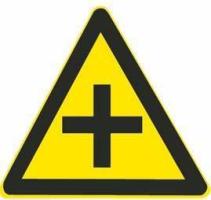
A. intersection
B. ring intersection
C. T-shaped intersection
D. Y-shaped intersection
Answer: A
19. It is illegal to change lanes without turning on indicators.
A. Right
B. Wrong
Answer: A
20. When a motor vehicle stops in snow, which lamp should be turned on?
A. Front and rear fog lamps, clearance lamp and rear position lamp
B. Reverse lamp, clearance lamp and rear position lamp
C. Headlamp, clearance lamp and rear position lamp
D. Hazard lamps, clearance lamp and rear position lamp
Answer: D