

1. In which section cannot overtake?
A. main streets
B. elevated road
C. crosswalk
D. ring express
Answer: C
2. A correct measure to avoid tire burst of motor vehicles is to lower the tire pressure.
A. Right
B. Wrong
Answer: B
3. When a motor vehicle temporarily stops at night, which lamp should be turned on?
A. Front and rear fog lamp, clearance lamp and rear position lamp
B. Head lamp, clearance lamp and rear position lamp
C. Hazard lamp, clearance lamp and rear position lamp
D. Reverse lamp, clearance lamp and rear position lamp
Answer: C
4. When use the brake of a motorcycle, use the front-wheel brake first, then use the back-wheel brake.
A. Right
B. Wrong
Answer: B
5. When encountering stopping and waiting in turn or slow-moving vehicles in front, the motorized vehicle may _________.
A. borrow road to overtake
B. occupy the opposite lane
C. follow the vehicles in front
D. cut in the waiting vehicles
Answer: C
6. When a motor vehicle passes over an overflowing bridge, what should the driver do after stopping and observing closely?
A. Change to a high gear and pass rapidly
B. Constantly observe the changes of the flow
C. Prepare to stop at any time
D. Change to a low gear and pass through at a constant speed
Answer: D
7. Which of the following vehicle in front in the same lane is not allowed to be overtaken?
A. the vehicle is making a stop
B. the vehicle is reducing speed to yield
C. the vehicle is taking a U turn
D. the vehicle is running normally
Answer: C
8. What should motor vehicle drivers do when parking temporarily on a rainy day?
A. Turn on hazard lamp
B. Turn on front and back fog lamp
C. Turn on low-beam
D. Set up warning sign at the back of the vehicle
Answer: A
9. When driving into the traffic flow on a main road from a relief road, drivers should speed up.
A. Right
B. Wrong
Answer: B
10. A motorized vehicle driver who deliberately covered or stained the license plate and placed the license plate unproperly, is subject to a ________.
A. 2-point penalty
B. 3-point penalty
C. 6-point penalty
D. 12-point penalty
Answer: D
11. When passing an intersection without traffic lights, the driver should go through as fast as possible.
A. Right
B. Wrong
Answer: B
12. When following other vehicles on the uphill section of a mountain road, what should the driver do if the vehicle in front stops?
A. Overtake from either side of the front vehicle
B. Stop close to the vehicle in front
C. Stop with a larger space from the vehicle in front
D. Sound the horn continuously to warn the other driver
Answer: C
13. If a driver has not received full penalty points, and the fine has not been paid, the penalty points will be transferred into the next scoring cycle.
A. Right
B. Wrong
Answer: A
14. A driver may drive on the road a motorized vehicle overhauled which has reached the saraped standard.
A. Right
B. Wrong
Answer: B
15. It is not safe for a female driver to wear high heels to drive a vehicle.
A. Right
B. Wrong
Answer: A
16. Illegally assembled motorized vehicle can be drived on road as long as it is thought to be safe.
A. Right
B. Wrong
Answer: B
17. What is the meaning of this sign?
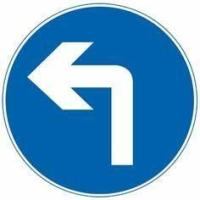
A. turn left
B. no going straight
C. straight-going lane
D. one-way road
Answer: A
18. What is the meaning of this sign?
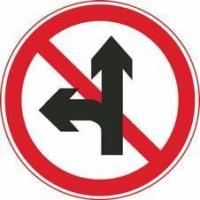
A. no going straight and no changing to left lane
B. no going straight and no left turn
C. allowed to go straight and turn left
D. no going straight and no right turn
Answer: B
19. When a motor vehicle encounters a group of youngsters bypassing the motor vehicles parking beside the road, the driver should slow down voluntarily and yield.
A. Right
B. Wrong
Answer: A
20. Traffic Police can detain the vehicle which is suspected of using the falsified or altered license plate and vehicle license.
A. Right
B. Wrong
Answer: A