

1. When overtaking on a rainy day, drivers should turn on headlamps and sound a long horn.
A. Right
B. Wrong
Answer: B
2. If a motorized vehicle driver reaches 12 penalty points during the period of probation, the probation qualification should be revoked.
A. Right
B. Wrong
Answer: A
3. When parking temporarily on a snowy day, drivers should turn on the headlamp and fog lamp.
A. Right
B. Wrong
Answer: B
4. What is the meaning of this sign?

A. bump road
B. high outburst road
C. low-lying road
D. hump bridge
Answer: B
5. Traffic Police can detain the vehicle according to law if it is suspected of using the label of inspection from other vehicle.
A. Right
B. Wrong
Answer: A
6. How should lamps be used when motor vehicle drivers pass through a two-way tunnel?
A. Turn on the hazard lamps
B. Turn on the high-beam
C. Turn on the fog lamp
D. Turn on the low-beam
Answer: D
7. How long is the period of probation after a motorized vehicle driver obtains his driving license for the first time or the permission to drive higher level vehicles.
A. 6 months
B. 12 months
C. 2 years
D. 3 months
Answer: B
8. A motorized vehicle runs on the road without a label of inspection, the traffic police can detain the vehicle.
A. Right
B. Wrong
Answer: A
9. Which shoud be taken along while driving?
A. vocational qualification certificate
B. ID card
C. driving license
D. work permits
Answer: C
10. When a motorcycle goes down a long slope, it should run at a lower gear and fully use the engine to brake.
A. Right
B. Wrong
Answer: A
11. What is the meaning of this sign?
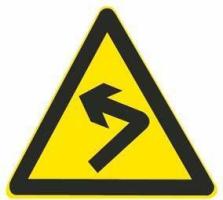
A. bypass from left side
B. continuous curves
C. sharp left curve
D. sharp right curve
Answer: C
12. Besides the administrative punishment, what kind of system implemented by the traffic control department of the public security organ to the driver who violated the traffic regulations?
A. violation registration system
B. mileage reward system
C. mandatory write-off system
D. accumulated penalty points system
Answer: D
13. When a motor vehicle passes over an overflowing bridge, what should the driver do after stopping and observing closely?
A. Change to a high gear and pass rapidly
B. Constantly observe the changes of the flow
C. Prepare to stop at any time
D. Change to a low gear and pass through at a constant speed
Answer: D
14. When the driver discovers a tire is leaking and steers the vehicle off the main driving lane, he/she should refrain from applying emergency braking so as to avoid a vehicle turnover or a rear-end collision arising from the late braking of the vehicle behind.
A. Right
B. Wrong
Answer: A
15. When the road maintenance vehicle and the engineering vehicle are on duty, the passing vehicles should avoid with care.
A. Right
B. Wrong
Answer: A
16. When driving on a muddy roads, it is easy for wheels to sideslip or skid, which leads to traffic accidents.
A. Right
B. Wrong
Answer: A
17. What should a motorized vehicle has while running on the road?
A. a label of keeping distance
B. a label of reminding danger
C. a label of inspection
D. a label of product qualification
Answer: C
18. Traffic Police can detain the accident vehicle according to law if it needs to be collected evidence of the road accident.
A. Right
B. Wrong
Answer: A
19. After a tire blows out and before the driver can control the speed of the vehicle, he should refrain from using the foot brake to stop the vehicle. Otherwise, a horizontal swing of the vehicle can cause greater danger.
A. Right
B. Wrong
Answer: A
20. The motorized vehicle driver who lives outside the jurisdiction of the issuing vehicle management station may apply to the vehicle management station at the place where he is living, for license change.
A. Right
B. Wrong
Answer: A