

1. When driving in a heavy rain, drivers should contro their speed to prevent their vehicles from sliding.
A. Right
B. Wrong
Answer: A
2. If a fast moving vehicle has a steering failure, using emergency braking can easily cause an overturn.
A. Right
B. Wrong
Answer: A
3. When the driver discovers a tire is leaking and steers the vehicle off the main driving lane, he/she should refrain from applying emergency braking so as to avoid a vehicle turnover or a rear-end collision arising from the late braking of the vehicle behind.
A. Right
B. Wrong
Answer: A
4. If a motor vehicle misses an exit on the expressway, the driver may reverse along the road shoulder.
A. Right
B. Wrong
Answer: B
5. What is the function of ABS during emergency braking?
A. Shortening the braking distance
B. Keeping steering capacity of the motor vehicle
C. Relief the braking inertia
D. Controlling directions automatically
Answer: B
6. When driving on an expressway, which of the following statements is correct?
A. Drivers may overtake on either the ramp, the acceleration lane or the deceleration lane
B. Drivers are prohibited from reversing, driving in the opposite direction or making a U turn by crossing the central dividing strip
C. Drivers may drive on the emergency lane in a non-emergency case
D. Drivers may test a motor vehicle or learn to drive
Answer: B
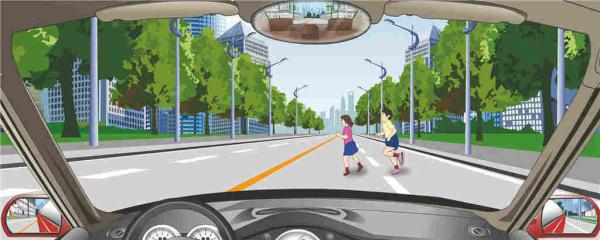
7. When such circumstances happen suddenly, drivers should reduce speed in a timely fashion or stop to yield.
A. Right
B. Wrong
Answer: A
8. When a motor vehicle moves through water, the driver should try to maintain a constant speed and sufficient power and pass through without stopping.
A. Right
B. Wrong
Answer: A
9. Which one of the following measures is correct when a motor vehicle intends to overtake but the vehicle in front refuses to yield?
A. Use a long-sounding horn
B. Follow the vehicle in front while turning high-beam
C. Wait for it to yield while keeping a safe distance
D. Use high-beam and low-beam alternatively
Answer: C
10. A driver should accelerate in advance to overtake then it is likely to meet with oncoming vehicles.
A. Right
B. Wrong
Answer: B
11. When driving in a strong wind, drivers should abruptly turn the steering wheel to return to the original direction if they feel the vehicle deviates horizontally due to a strong gale.
A. Right
B. Wrong
Answer: B
12. As shown in the flash, what should the motor vehicle driver do when encountering this situation?
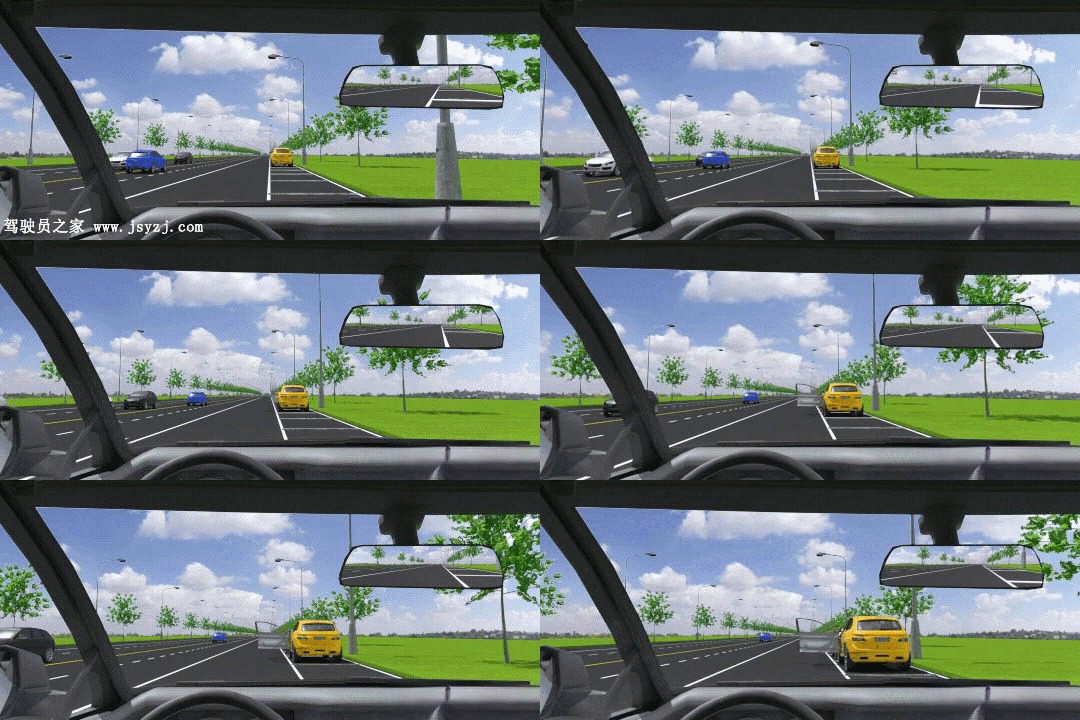
A. Reserve a safe crosswise distance and cut speed
B. Keep a normal speed
C. Use the emergency brake when approaching
D. Speed up and pass rapidly
Answer: A
13. When there is a braking failure on a downhill road the driver should change the gear to one position or two positions lower, and control the speed by taking advantage of the braking role of the engine.
A. Right
B. Wrong
Answer: A
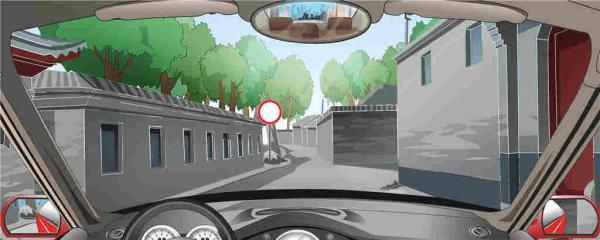
14. The sign on the left indicates vehicles are allowed to drive on the section ahead.
A. Right
B. Wrong
Answer: B
15. When the motor vehicle stops on a downhill section how should the driver use the foot brake?
A. Earlier than on a level road
B. Later than on a level road
C. As timely as on a level road
D. Gently depress the foot brake pedal
Answer: A
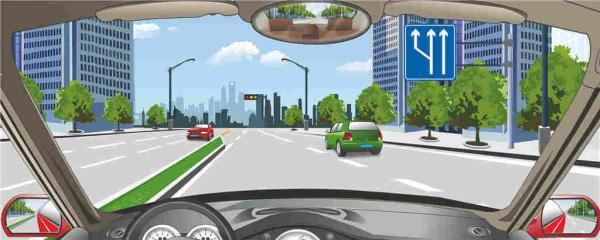
16. The sign on the right indicates a bypass flow intersection ahead.
A. Right
B. Wrong
Answer: B
17. The sign on the right warns of an unguarded railway crossing 150 meters ahead.
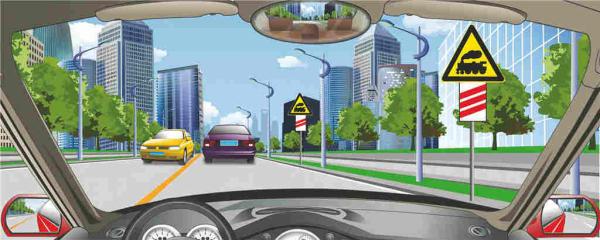
A. Right
B. Wrong
Answer: A
18. When a motor vehicle catches fire, the driver should manage to park the vehicle in an open place far away from urban areas, buildings, trees, other motor vehicles and flammable materials.
A. Right
B. Wrong
Answer: A
19. Dangerous chemicals possess the characteristics of explosion, inflammation, poison, erosion and radiation.
A. Right
B. Wrong
Answer: A
20. At 3: 40 a.m. one day, Mr. Sun drove a large bus with 54 passengers(capacity 55 people). At the spot of 229 kilometers mark by 300 meters on Suiyue Expressway, the bus had a rear-end collision with a heavy semi-trailer driven by Mr. Li when passengers were getting off from the bus. As a result of the accident, 26 people were killed and 29 injured. According to the investigation afterwards, Mr. Li had been driving the bus since he left the place of departure at 6 p.m. the day before without any rest. What are the main illegal acts of the two drivers?
A. Mr. Sun illegally parked
B. Mr. Sun carried more passengers than permitted
C. Mr. Li exceeded speed limit
D. Mr. Li kept driving when tired
Answer: AD