

1. When a motorcycle turns at an excessively high speed, it can easily dash out of a curve or skid sideways.
A. Right
B. Wrong
Answer: A
2. What is the meaning of this sign?
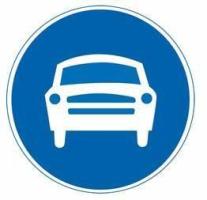
A. no passing for small vehicle
B. passing for small vehicle only
C. passing for motorized vehicle
D. no passing for small vehicle
Answer: C
3. When use the brake of a motorcycle, use the front-wheel brake first, then use the back-wheel brake.
A. Right
B. Wrong
Answer: B
4. If a motorized vehicle runs 50% faster than the specified speed limit, the driver is subject to a 3-point penalty.
A. Right
B. Wrong
Answer: B
5. Drivers who ride motorcycles are able to not wear safety helmets.
A. Right
B. Wrong
Answer: B
6. When a motorcycle reaches a muddy or burst-and-muddy section, the driver should stop, observe and select the level and solid section or the section with vehicle tracks.
A. Right
B. Wrong
Answer: A
7. Traffic Police can detain the driver according to law, if the driver drives a motorized vehicle which is suspected of reaching the write-off standard.
A. Right
B. Wrong
Answer: B
8. How should lamps be used when a motor vehicle meets an oncoming bicycle on a narrow road or a narrow bridge at night?
A. Continuously change between low-beam and high-beam
B. Use clearance lamp
C. Use high-beam
D. Use low-beam
Answer: D
9. How to use lights when pulling over on road?
A. turn on the hazard lights
B. turn on the right-turn signal in advance
C. use the high and low beam lights alternately
D. not need to use any light to indicate
Answer: B
10. Turning on the high-beam is an effective way to improve visibility in fog weather.
A. Right
B. Wrong
Answer: B
11. When causing a road accident involving property damage, the parties to the accident may leave the scene if they have no dispute over the fact and cause.
A. Right
B. Wrong
Answer: A
12. Traffic lights are divided into red, green and yellow light.
A. Right
B. Wrong
Answer: A
13. Motor vehicle drivers don’t need to use any lamp at night when passing through a road section where the street light condition is good.
A. Right
B. Wrong
Answer: B
14. Traffic Police can detain the accident vehicle according to law if it needs to be collected evidence of the road accident.
A. Right
B. Wrong
Answer: A
15. When causing a road accident involving property damage, the party should leave the scene on his own but he does not leave and causes a traffic jam, he may be subject to a fine of 200 yuan.
A. Right
B. Wrong
Answer: A
16. Which of the following vehicle in front in the same lane is not allowed to be overtaken?
A. the vehicle is making a stop
B. the vehicle is reducing speed to yield
C. the vehicle is taking a U turn
D. the vehicle is running normally
Answer: C
17. Driving and smoking has no negative effect on safe driving
A. Right
B. Wrong
Answer: B
18. Which of the following vehicle in front in the same lane is not allowed to be overtaken?
A. large bus or large truck
B. taxis
C. ambulance on duty
D. public bus
Answer: C
19. When passing a sharp curve, motor vehicle drivers may overtake if there are few other vehicles on the road.
A. Right
B. Wrong
Answer: B
20. Before driving, it is necessary to check whether the cooling liquid, engine oil and fuel oil, are leaking.
A. Right
B. Wrong
Answer: A