

1. A motorized vehicle is not allowed to stop in the section 50 meters to the bridge, steep slope or tunnel.
A. Right
B. Wrong
Answer: A
2. What is the meaning of this sign?
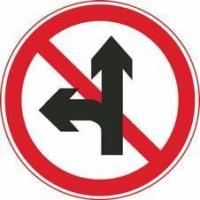
A. no going straight and no changing to left lane
B. no going straight and no left turn
C. allowed to go straight and turn left
D. no going straight and no right turn
Answer: B
3. If a person escapes after causing a traffic accident and constitutes a crime, his driving license should be revoked and he is banned _____ from re-obtaining a driving license.
A. within 5 years
B. within 10 years
C. within 20 years
D. for lifetime
Answer: D
4. When driving on a road covered with ice and snow drivers should not use the emergency brake but can apply a sharp turn.
A. Right
B. Wrong
Answer: B
5. During normal driving, the driver should do his/her best to run close to or on the central line so as not to allow oncoming vehicles any opportunity to occupy his own route.
A. Right
B. Wrong
Answer: B
6. What is the meaning of this sign?
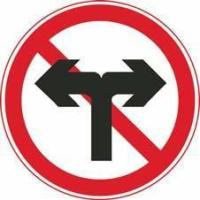
A. no U turn at intersection
B. no changing lane from both sides
C. no left or right turn
D. no going straight
Answer: C
7. When the driver discovers that steering is stiff, the wrong measure is to ___________.
A. Reduce speed and stop the vehicle as fast as possible
B. Stop at a safe place
C. Continue to drive
D. Identify the cause
Answer: C
8. In which situation the traffic police may detain the vehicle?
A. no lable of inspection
B. no ID card
C. no lable of environmental protection
D. no vehicle registration papers
Answer: A
9. When passing an intersection, vehicle motor drivers are not allowed to overtake.
A. Right
B. Wrong
Answer: A
10. Traffic Signs and traffic markings are not traffic signals.
A. Right
B. Wrong
Answer: B
11. When a motorized vehicle breaks down at night, and is difficult to move, the driver should turn on the hazard lights, the contour lights and the tail lights.
A. Right
B. Wrong
Answer: A
12. If a motorized vehicle driver allows his vehicle to be driven by a person whose driving license has been detained, the traffic police will serve an oral warning.
A. Right
B. Wrong
Answer: B
13. If a motorized vehicle causes a traffic accident on the road, the driver should immediately move the vehicle to the roadside.
A. Right
B. Wrong
Answer: B
14. Which is subject to a 6-point penalty?
A. use other vehicle’s vehicle license
B. run 50% faster than the prescribed speed limit
C. illegally occupy emergency lane
D. drive after drinking
Answer: C
15. What is the meaning of this sign?
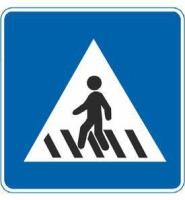
A. crosswalk
B. students’ passage
C. watch for pedestrians
D. children’s passage
Answer: A
16. If a motorized vehicle driver escapes after causing a major traffic accident which has caused human death, the driver is subject to a prison term of ________.
A. more than 7 years
B. less than 3 years
C. 3 ~ 7 years
D. more than 10 years
Answer: C
17. It is illegal to change lanes without turning on indicators.
A. Right
B. Wrong
Answer: A
18. What should motor vehicle drivers do when approaching an oncoming vehicle on a frozen road?
A. Cut speed as approaching each other
B. Pass each other by speeding up properly
C. Pass each other slowly by cutting speed in advance
D. Pass each other along the central line to the best
Answer: C
19. What is the meaning of this sign?
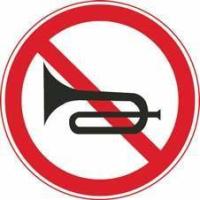
A. no long time honking
B. honk discontinuously
C. reduce speed and honk
D. no honking
Answer: D
20. What is the meaning of this sign?

A. more vehicles section
B. passing slowly
C. jammed section
D. construction section
Answer: B