

1. What is the function of ABS during emergency braking?
A. Shortening the braking distance
B. Keeping steering capacity of the motor vehicle
C. Relief the braking inertia
D. Controlling directions automatically
Answer: B
2. When a motor vehicle breaks down and cannot be moved away from the emergency lane or the road shoulder, the driver and all passengers should get off the vehicle and wait on the road side instead of leaving the expressway.
A. Right
B. Wrong
Answer: B
3. When there is a braking failure on a downhill road, the driver should immediately try to find and drive to an emergency lane; after stopping the vehicle on the emergency lane, the driver should pull up the stopping brake so as to prevent a second danger arising from the vehicle sliding.
A. Right
B. Wrong
Answer: A
4. The red car is allowed to drive on this lane.
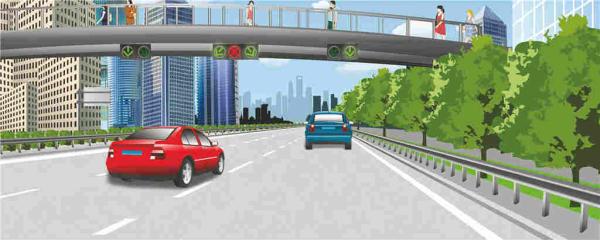
A. Right
B. Wrong
Answer: B
5. Mr. Zhou drove a light van (with 22 passengers) on the Bingcha Highway. At the spot of 79 kilometers mark by 150 meters of the highway, the van fell into the valley on one side, killing 12 people and injuring 10. What is the main illegal act committed by Mr. Zhou?
A. Driving a motor vehicle having failed to accept inspection in time
B. Carrying passengers on a freight motor vehicle
C. Speeding
D. Fatigued driving
Answer: B
6. When a motor vehicle moves through water, the driver should try to maintain a constant speed and sufficient power and pass through without stopping.
A. Right
B. Wrong
Answer: A
7. The sign on the right warns of a guarded crossing 150 meters ahead.
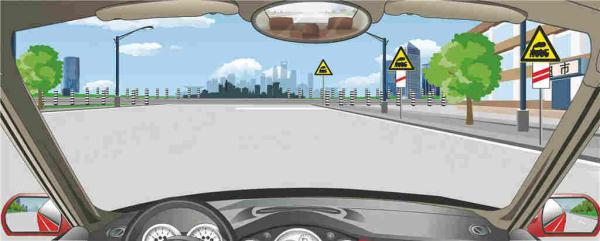
A. Right
B. Wrong
Answer: B
8. Before a motor vehicle enters a tunnel, the driver should adjust the speed in accordance with the indication of the traffic sign at the entrance of the tunnel.

A. Right
B. Wrong
Answer: A
9. When approaching a vehicle on a narrow slope, which one of the following ways is correct?
A. The descending vehicle yields to the ascending
B. The vehicle which is further from the slope crest should yield
C. The ascending vehicle yields to the descending
D. If the descending vehicle has reached the midpoint while the ascending vehicle has not yet set out, the descending vehicle must yield.
Answer: A
10. The sign on the left indicates no U-turn at the intersection ahead.

A. Right
B. Wrong
Answer: A
11. When rescuing a wounded person suffering blood loss in an emergency, it is necessary to first stop the bleeding by compression before other treatments are taken in accordance with the conditions of bleeding.
A. Right
B. Wrong
Answer: A
12. After entering the acceleration lane of an expressway, the driver should increase the speed to how many kilometers per hour?
A. More than 30 km/hour
B. More than 40 km/hour
C. More than 50 km/hour
D. More than 60 km/hour
Answer: D
13. When carrying a wounded person in a coma, rescue personnel should try to let the unconscious person remain in the supine position.
A. Right
B. Wrong
Answer: B
14. The sign above the tunnel indicates a height limit of 3.5 meters on the road ahead.
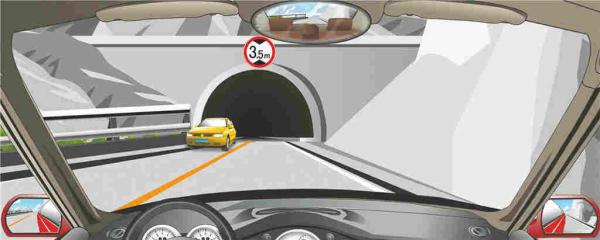
A. Right
B. Wrong
Answer: A
15. What should drivers do when encountering a rainstorm on a common road and the windscreen-wiper fails to make sight clear?
A. Drive at a reduced speed
B. Drive carefully
C. Cut speed in time and pull over
D. Drive at a normal speed
Answer: C
16. When the motor vehicle stops on an uphill section, how should the driver use the foot brake?
A. Earlier than on a level road
B. Later than on a level road
C. As timely as on a level road
D. Strongly depress the foot brake pedal
Answer: B
17. Drivers are allowed to cross the broken and solid white line on the road when changing lanes or pulling over.
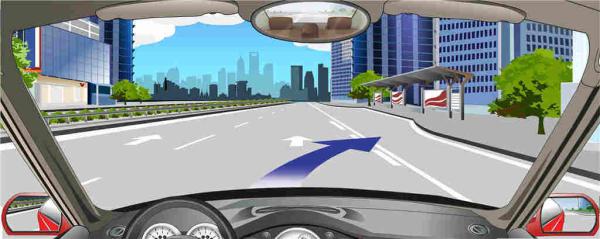
A. Right
B. Wrong
Answer: A
18. When the rear wheels of a motor vehicle skid sideways on a muddy road, the driver should turn the steering wheel in the opposite direction of the side skid.
A. Right
B. Wrong
Answer: B
19. The sign on the right indicates a one-kilometer distance from ETC toll station ahead.
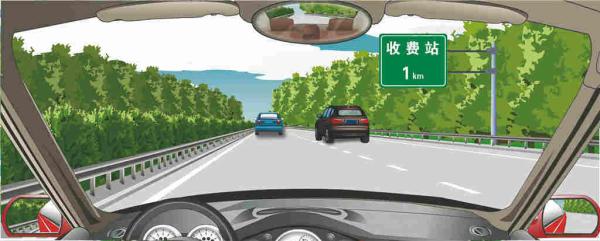
A. Right
B. Wrong
Answer: B
20. When encountering such pedestrians while driving, a longer safety distance should be kept by drivers.
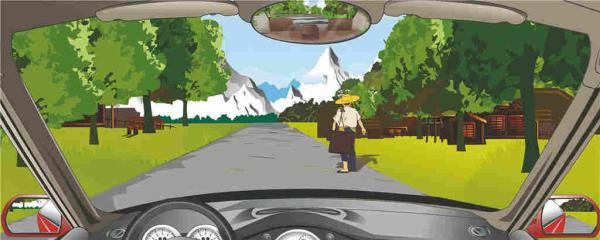
A. Right
B. Wrong
Answer: A