

1. When a rear tire of a motorcycle blows out, the driver should ________.
A. Swiftly turn the steering handlebar to adjust
B. Firmly hold the steering handlebar with both hands
C. Swiftly turn the steering handlebar to the opposite direction
D. Swiftly take braking measures
Answer: B
2. What is the meaning of this sign?
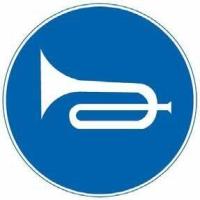
A. no honking the tweeter
B. no honking the woofer
C. should honk
D. no honking
Answer: C
3. According to regulations, motorcycle driver should wear _______.
A. Glasses
B. A special safety helmet
C. Gloves
D. Safety kneepads
Answer: B
4. What should be checked before driving?
A. No parts need to be checked
B. Whether the tires have been cleaned
C. Where the spare tire is placed
D. The fastening and air pressure of tires
Answer: D
5. When passing a sharp curve, motor vehicle drivers may overtake if there are few other vehicles on the road.
A. Right
B. Wrong
Answer: B
6. A motorcycle is not permitted to tow other vehicles or to be towed by other vehicles.
A. Right
B. Wrong
Answer: A
7. Traffic Signs and traffic markings are not traffic signals.
A. Right
B. Wrong
Answer: B
8. How long is the period of probation after a motorized vehicle driver obtains his driving license for the first time or the permission to drive higher level vehicles.
A. 6 months
B. 12 months
C. 2 years
D. 3 months
Answer: B
9. It is not a bad habit for a driver to frequently change lanes.
A. Right
B. Wrong
Answer: B
10. If one drives an illegalled assembled motorized vehicle, he should not only pay the fine, but also ________ .
A. be confiscated the driving license
B. be revoked the driving permission
C. be forced to recover the vehicle condition
D. be revoked the driving license
Answer: D
11. What should be done by the driver who intends to overtake but the motor vehicle in front neither reduces its speed nor allows the right of way?
A. Continuously sounding the horn and accelerating to overtake
B. Accelerating and continuing to overtake
C. Refraining from overtaking
D. Following the vehicle in front closely and finding a chance to overtake
Answer: C
12. How to ensure motor vehicles have sufficient power when driving uphill?
A. Downshift before reducing speed
B. Downshift after reducing speed
C. Downshift when the speed is excessively low
D. Downshift to the fullest extent
Answer: A
13. When finding a tire burst on the road, the driver should gently depress the brake pedal, reduce speed and stop the vehicle slowly.
A. Right
B. Wrong
Answer: A
14. When a motor vehicle reaches a muddy or burst-and-muddy section of the road, the driver should stop, observe and select a level and solid section or a section with vehicle tracks.
A. Right
B. Wrong
Answer: A
15. When a motor vehicle temporarily stops at night, which lamp should be turned on?
A. Front and rear fog lamp, clearance lamp and rear position lamp
B. Head lamp, clearance lamp and rear position lamp
C. Hazard lamp, clearance lamp and rear position lamp
D. Reverse lamp, clearance lamp and rear position lamp
Answer: C
16. Turn on the left-turn signal in advance when making a U turn on the road.
A. Right
B. Wrong
Answer: A
17. What is the max speed on muddy road?
A. 15km/hr
B. 20km/hr
C. 40km/hr
D. 30km/hr
Answer: D
18. Which of the following vehicle in front in the same lane is not allowed to be overtaken?
A. police car on duty
B. large bus or large truck
C. taxis
D. public bus
Answer: A
19. When evading an emergency, except for being calm what principle should be held by drivers?
A. Evading people first and then objects
B. Evading objects first and then vehicles
C. Evading vehicles first and then people
D. Evading objects first and then people
Answer: A
20. How should lamps be used when motor vehicle drivers pass through a two-way tunnel?
A. Turn on the hazard lamps
B. Turn on the high-beam
C. Turn on the fog lamp
D. Turn on the low-beam
Answer: D