

1. During normal driving, the driver should do his/her best to run close to or on the central line so as not to allow oncoming vehicles any opportunity to occupy his own route.
A. Right
B. Wrong
Answer: B
2. When following other vehicles on the uphill section of a mountain road, what should the driver do if the vehicle in front stops?
A. Overtake from either side of the front vehicle
B. Stop close to the vehicle in front
C. Stop with a larger space from the vehicle in front
D. Sound the horn continuously to warn the other driver
Answer: C
3. If a motorized vehicle driver has caused a major accident in violation of the traffic regulations which has caused heavy loss to public or private property, the driver is subject to a prison term of less than 3 years or a criminal detention.
A. Right
B. Wrong
Answer: A
4. A motorized vehicle is not allowed to stop in the section 50 meters to the narrow road less than 4 meters width.
A. Right
B. Wrong
Answer: A
5. The width of loaded goods should ______________ from a three-wheel motorcycle.
A. not exceed 0.15 meter
B. not exceed
C. not exceed 0.20 meter
D. not exceed 0.25 meter
Answer: B
6. When encountering an obstacle on one side of the road, what should vehicles do as they approach each other?
A. The vehicle not encountering an obstacle should Yield to the other vehicle
B. The slower vehicle should yield to the faster
C. The vehicle encountering an obstacle should yield to the other vehicle
D. The faster vehicle should yield to the slower
Answer: C
7. The driver who chases and races while driving on the road, and commits serious acts is subject to ______
A. a prison term of 6 months
B. a prison term of more than 1 year
C. a criminal restriction and a fine
D. a criminal detention and a fine
Answer: D
8. It is unsafe to ride a motorcycle by high-heel shoes.
A. Right
B. Wrong
Answer: A
9. Traffic Police only imposes a fine if a vehicle is suspected of using the falsified or altered label of inspection.
A. Right
B. Wrong
Answer: B
10. When a tire blowout on the road, the driver should control the direction of the vehicle and use emergency braking to bring the motorcycle swiftly to a stop.
A. Right
B. Wrong
Answer: B
11. If the vehicle has no license plate, label of inspection or label of insurance, preserve the scene and immediately report to the police.
A. Right
B. Wrong
Answer: A
12. Besides the administrative punishment, what kind of system implemented by the traffic control department of the public security organ to the driver who violated the traffic regulations?
A. violation registration system
B. mileage reward system
C. mandatory write-off system
D. accumulated penalty points system
Answer: D
13. When a motorized vehicle makes a U turn, turns around or goes down a slope, the maximum speed should not exceed 40 kilometers per hour.
A. Right
B. Wrong
Answer: B
14. While driving a motorcycle, it is permitted to keep one hand on the handlebar but not allowed two hands leave handle bars at the same time.
A. Right
B. Wrong
Answer: B
15. A motorized vehicle is not allowed to stop in the section 50 meters to the bridge, steep slope or tunnel.
A. Right
B. Wrong
Answer: A
16. When a motorcycle goes downhill on a mountain road, it is not allowed to overtake.
A. Right
B. Wrong
Answer: A
17. What is the meaning of this sign?
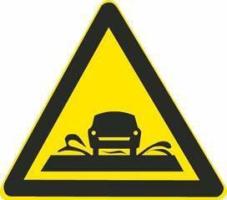
A. muddy road
B. low-lying road
C. overflowing road
D. ferry
Answer: C
18. A driver can park the vehicle by borrowing the sidewalk if he cannot find the parking area.
A. Right
B. Wrong
Answer: B
19. When causing a road accident involving property damage, the parties to the accident may leave the scene if they have no dispute over the fact and cause.
A. Right
B. Wrong
Answer: A
20. What is the meaning of this sign?
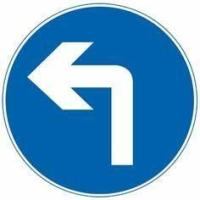
A. turn left
B. no going straight
C. straight-going lane
D. one-way road
Answer: A