

1. When driving on a rough road, the driver should use low gear to keep low speed; try to choose roads with big pits to reduce bumpy feeling.
A. Right
B. Wrong
Answer: B
2. A driver may drive a motorized vehicle after the driving license has been lost within 3 months.
A. Right
B. Wrong
Answer: B
3. When a motorized vehicle runs in a foggy weather, the driver should turn on the fog light and the hazard lights.
A. Right
B. Wrong
Answer: A
4. When a motor vehicle passes over an inundated road drivers should change to a high gear and pass rapidly.
A. Right
B. Wrong
Answer: B
5. When encountering stopping in turn or slow-moving vehicles in front at an intersection where lanes are reduced, the motorized vehicle should _________.
A. enter the intersection from road shoulder by the right side of the vehicle in front
B. enter the intersection from the side of interspace
C. pass alternately with one vehicle each lane to enter the intersection
D. change to left lane and cut in to enter the intersection
Answer: C
6. What is the meaning of this sign?
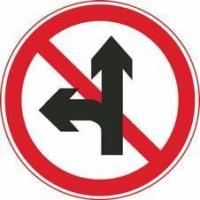
A. no going straight and no changing to left lane
B. no going straight and no left turn
C. allowed to go straight and turn left
D. no going straight and no right turn
Answer: B
7. Change driving license before of expiration.
A. 60 days
B. 30 days
C. 90 days
D. 6 months
Answer: C
8. Traffic Police can detain the driver according to law, if the driver drives a motorized vehicle which is suspected of reaching the write-off standard.
A. Right
B. Wrong
Answer: B
9. When the tire pressure is too low, what can happen when driving at a high speed?
A. Tire pressure will be unstable
B. Tire pressure will increase
C. Driving resistance will decrease
D. The tire will burst
Answer: D
10. If a motorized vehicle driver has caused a major traffic accident in violation of the traffic regulations which has caused human death due to his escaping, the driver is subject to a prison term of 3 years ~ 7 years.
A. Right
B. Wrong
Answer: B
11. Driving a motorized vehicle on the highway which has no central line, the maximum speed can not exceed 70 kilometers per hour.
A. Right
B. Wrong
Answer: B
12. In which section cannot overtake?
A. main streets
B. elevated road
C. crosswalk
D. ring express
Answer: C
13. When two vehicles approach each other on a foggy day, what is the best method of safe driving?
A. Turn on the high-beam
B. Slowdown and maintain a large safety distance
C. Turn on the low-beam
D. Turn on the fog lamp
Answer: B
14. Which is subject to a 6-point penalty?
A. use other vehicle’s vehicle license
B. run 50% faster than the prescribed speed limit
C. illegally occupy emergency lane
D. drive after drinking
Answer: C
15. If a motorized vehicle driver allows his vehicle to be driven by a person whose driving license has been detained, the traffic police will serve an oral warning.
A. Right
B. Wrong
Answer: B
16. The wrong measure to use the brake of a motorcycle is to __________.
A. Simultaneously use the front and back brakes
B. Use the front brake first
C. Use the back brake first
D. Avoid using the front brake too early
Answer: B
17. When driving in a strong wind, drivers should abruptly turn the steering wheel to return to the original direction if they feel the vehicle deviates horizontally due to a strong gale.
A. Right
B. Wrong
Answer: B
18. When driving on a road covered with ice and snow, the motor vehicle may spin or slide when increasing the speed urgently, due to the loss of vehicle stability.
A. Right
B. Wrong
Answer: A
19. When driving in thick or extremely thick fog, what should the driver do due to the low visibility in such weather?
A. Turn on the headlamp and drive slowly
B. Turn on the fog lamp and drive slowl
C. Park in a safe place
D. Drive slowly close to the roadside
Answer: C
20. What is the most frequent problem for driving on a muddy road?
A. High resistance force
B. Sideways slide
C. The motor vehicle bumps
D. Steering failure
Answer: B