

1. When a motor vehicle moves through water, drivers should intermittently and gently depress the brake pedal in order to restore braking efficiency.
A. Right
B. Wrong
Answer: A
2. If a person who has caused a major traffic accident and if his act constitutes a crime, he should be held for _________.
A. criminal liability
B. civil liability
C. direct liability
D. economic liability
Answer: A
3. How long can a driver drives without rest?
A. less than 6hrs
B. less than 8hrs
C. less than 10hrs
D. less than 4hrs
Answer: D
4. What is the meaning of this sign?
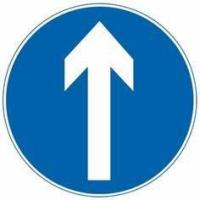
A. straight-going lane
B. going straight only
C. one-way road
D. no going straight
Answer: B
5. Motor vehicle drivers may borrow a special lane for other vehicle types, if one exists, to overtake.
A. Right
B. Wrong
Answer: B
6. A person who falsifies, alters driving license or uses falsified, altered driving license, and if his act constitutes a crime, he should be held for criminal liabilities according to law.
A. Right
B. Wrong
Answer: A
7. The police can detain the vehicle if one drives a vehicle without ______
A. driving license
B. ID card
C. pass paper
D. qualification certificate
Answer: A
8. When a motorcycle braking on a road covered by ice and snow, the driver should adopt point braking and prepare their feet for landing when braking.
A. Right
B. Wrong
Answer: A
9. What is the meaning of this sign?
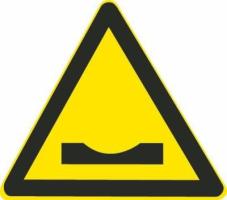
A. bump road
B. low-lying road
C. high outburst road
D. hump bridge
Answer: B
10. Traffic Police can detain the accident vehicle according to law if it needs to be collected evidence of the road accident.
A. Right
B. Wrong
Answer: A
11. What is the meaning of this sign?
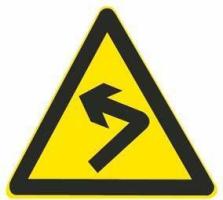
A. bypass from left side
B. continuous curves
C. sharp left curve
D. sharp right curve
Answer: C
12. What is the meaning of this sign?
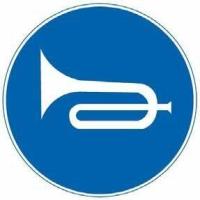
A. no honking the tweeter
B. no honking the woofer
C. should honk
D. no honking
Answer: C
13. After setting off from the roadside, motor vehicle drivers should speed up as soon as possible and make a sharp left-turn in order to drive into the normal lane.
A. Right
B. Wrong
Answer: B
14. A motorized vehicle driver who escapes after causing a traffic accident but his conduct does not constitute a crime, is subject to a ________.
A. 3-point penalty
B. 2-point penalty
C. 12-point penalty
D. 6-point penalty
Answer: C
15. Traffic Police can detain the vehicle according to law if it is suspected of using the label of insurance from other vehicle.
A. Right
B. Wrong
Answer: A
16. Speed up when passing the overflowing road.
A. Right
B. Wrong
Answer: B
17. Serious wave will appear when the front tire blows out; the driver should release the accelerator, firmly hold the steering wheel with both hands, quickly gradually break down, and stop to yield.
A. Right
B. Wrong
Answer: A
18. What is the meaning of this sign?
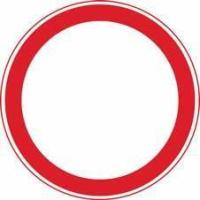
A. No passing
B. driving at reduced speed
C. time limit for entering
D. no entering
Answer: A
19. When driving in icy and snowy weather, because of the reduction of the stability, it is easy for the wheels to race or slip when rapidly speeding up.
A. Right
B. Wrong
Answer: A
20. How to use lights when overtaking at night?
A. turn off the high beam light
B. turn on high beam lights
C. use fog lights
D. using the high and low beam lights alternately
Answer: D