

1. A person who has taken the state-controlled psychiatric substances can drive motorized vehicle in short distance.
A. Right
B. Wrong
Answer: B
2. When driving in a heavy rain, drivers should contro their speed to prevent their vehicles from sliding.
A. Right
B. Wrong
Answer: A
3. When approaching a vehicle on a narrow slope, which one of the following ways is correct?
A. The descending vehicle yields to the ascending
B. The vehicle which is further from the slope crest should yield
C. The ascending vehicle yields to the descending
D. If the descending vehicle has reached the midpoint while the ascending vehicle has not yet set out, the descending vehicle must yield.
Answer: A
4. When two vehicles approach each other on a foggy day, what is the best method of safe driving?
A. Turn on the high-beam
B. Slowdown and maintain a large safety distance
C. Turn on the low-beam
D. Turn on the fog lamp
Answer: B
5. Driving a motorized vehicle on the road should be required to be with a license plate.
A. Right
B. Wrong
Answer: A
6. What is the meaning of this sign?
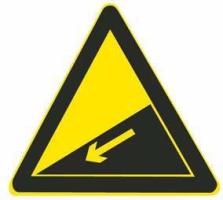
A. embankment road
B. steep uphill road
C. continuous up slopes
D. steep downhill road
Answer: D
7. When the driver discovers a tire is leaking and steers the vehicle off the main driving lane, he/she should refrain from applying emergency braking so as to avoid a vehicle turnover or a rear-end collision arising from the late braking of the vehicle behind.
A. Right
B. Wrong
Answer: A
8. What dangerous acts can’t the driver conduct when driving downhill?
A. slide the vehicle in the neutral gear
B. driving in lower gear
C. braking to reduce speed
D. changing to the lower gear in advance
Answer: A
9. Which of the following measures is incorrect when a motor vehicle stops?
A. Stop at a stipulated place
B. Avoid stopping on pedestrian streets
C. Avoid obstructing the passing of other motor vehicles and pedestrians when temporarily stops on the road
D. Stop on the non-motor vehicle lane
Answer: D
10. A motorized vehicle driver who escapes after causing a traffic accident but his conduct does not constitute a crime, is subject to a ________.
A. 3-point penalty
B. 2-point penalty
C. 12-point penalty
D. 6-point penalty
Answer: C
11. It is illegal to change lanes without turning on indicators.
A. Right
B. Wrong
Answer: A
12. What should be checked before driving?
A. No parts need to be checked
B. Whether the tires have been cleaned
C. Where the spare tire is placed
D. The fastening and air pressure of tires
Answer: D
13. It is not a bad habit for a driver to frequently change lanes.
A. Right
B. Wrong
Answer: B
14. When evading an emergency, except for being calm what principle should be held by drivers?
A. Evading people first and then objects
B. Evading objects first and then vehicles
C. Evading vehicles first and then people
D. Evading objects first and then people
Answer: A
15. A driver should drive the vehicles in accordance with the qualification listed on the driving license.
A. Right
B. Wrong
Answer: A
16. When causing a road accident involving property damage, the parties to the accident may leave the scene if they have no dispute over the fact and cause.
A. Right
B. Wrong
Answer: A
17. If a motorized vehicle driver has caused a major traffic accident in violation of the traffic regulations which has caused human death due to his escaping, the driver is subject to a prison term of _________.
A. less than 2 years
B. less than 3years
C. less than 7years
D. more than 7 years
Answer: D
18. When a motorcycle goes downhill, it may fully use the neutral gear and slide.
A. Right
B. Wrong
Answer: B
19. The wrong measure to ride a motorcycle in summer is to __________.
A. Drive at a high speed for a long time
B. Control the speed by the accelerator
C. Avoid using the brake
D. Avoid loading people or cargoes
Answer: A
20. What should be done by the driver who intends to overtake but finds that the vehicle in front is also overtaking?
A. Following the vehicle in front closely and finding a chance to overtake it
B. Accelerating to overtake forcefully
C. Continuously sounding the horn to urge the vehicle in front to yield
D. Refraining from overtaking and letting the vehicle in front overtake first
Answer: D