

1. When discovering a vehicle behind wanting to overtake while driving, the driver should _______.
A. Maintain the original speed
B. Reduce speed, observe and run by the right side to yield
C. Speed up and go ahead by the right side
D. Not yield
Answer: B
2. When driving in icy and snowy weather, light reflection from the accumulated snow can easily make a driver feel dizzy and have an illusion.
A. Right
B. Wrong
Answer: A
3. When a vehicle goes uphill on a mountain road, it should change to a lower gear in a timely, accurate and rapid manner so as to avoid a situation in which driving at a high gear can reduce the power of the engine.
A. Right
B. Wrong
Answer: A
4. How to run on this road?
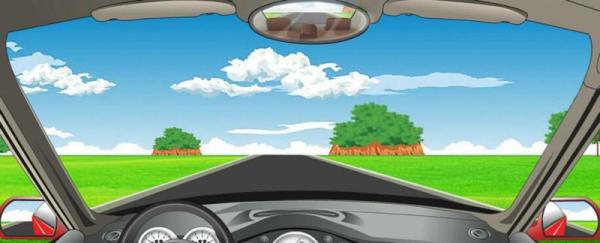
A. run in the middle of the road
B. run on both side of the road
C. run according to lanes
D. go forward at will
Answer: A
5. A driver can park the vehicle by borrowing the sidewalk if he cannot find the parking area.
A. Right
B. Wrong
Answer: B
6. It lights to indicate that ______

A. the side fans work
B. air external circulation
C. the front fan works
D. air internal circulation
Answer: C
7. This set of the hand signals of the traffic police indicates that the vehicles should ___ .
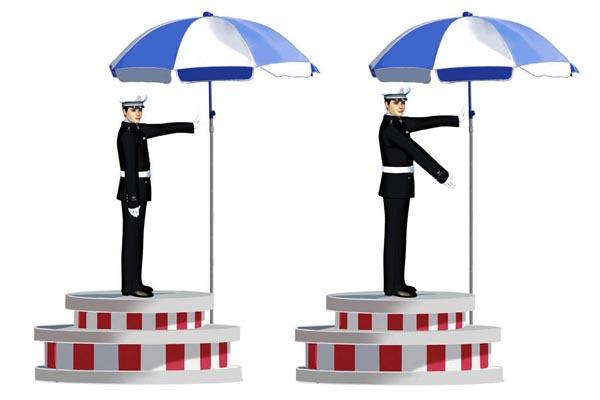
A. wait to turn left
B. pull over
C. turn right
D. reduce speed and pass slowly
Answer: C
8. What does this symbol indicate?

A. snowy starting mode
B. air circulation
C. air condition cooling mode
D. cooling or warming fan
Answer: D
9. The seat belts can reduce the injury of the driver and passengers when there is a collision.
A. Right
B. Wrong
Answer: A
10. When the tire pressure is too low, the fast-running tire can change its shape like waves and increase its temperature, which in turn can cause ________.
A. Even lower tire pressure
B. Increases resistance to the vehicle
C. Tire blowout
D. Unstable tire pressure
Answer: C
11. Overtaking is allowed when passing a level crossing in city where no train passes.
A. Right
B. Wrong
Answer: B
12. After a vehicle enters the ramp, the driver should swiftly increase the speed to more than 60 kilometers per hour.
A. Right
B. Wrong
Answer: B
13. Registration alternation is not needed when _____
A. change engine
B. add anti-collision device
C. change vehicles colour
D. change the chassis
Answer: B
14. Which should be taken along while driving?
A. vocational qualification certificate
B. ID card
C. driving license
D. work permits
Answer: C
15. A motorized vehicle driver who has not yielded to the school bus according to stipulations is subject to a 6-point penalty.
A. Right
B. Wrong
Answer: A
16. May not turn on the turn signal when overtaking.
A. Right
B. Wrong
Answer: B
17. A motorized vehicle is not allowed to make a U turn at the level crossing, bridge, steep slope, tunnel or dangerous road section.
A. Right
B. Wrong
Answer: A
18. When the driver senses a tire blowout on the road, he should control the direction of the vehicle, gently depress the brake pedal to slowly reduce the speed and gradually park the vehicle steadily on the roadside.
A. Right
B. Wrong
Answer: A
19. A person whose driving license has been destroyed cannot drive a motorized vehicle.
A. Right
B. Wrong
Answer: A
20. If a motorized vehicle driver causes a traffic accident and runs away but his conduct does not constitute a crime, he is subject to a 12-point penalty.
A. Right
B. Wrong
Answer: A